
Signed and dated 1622, this radiant scene of Queen Esther before her husband, the Persian king Ahasuerus, is the first Flemish early modern painting to be acquired by the Art Institute of Chicago in nearly fifteen years. Rediscovered in 2006, it illuminates the fine, colorful multi-figure compositions and sumptuous textiles of Frans Francken II’s early maturity in Antwerp while also depicting a strong female protagonist as a moral exemplar.
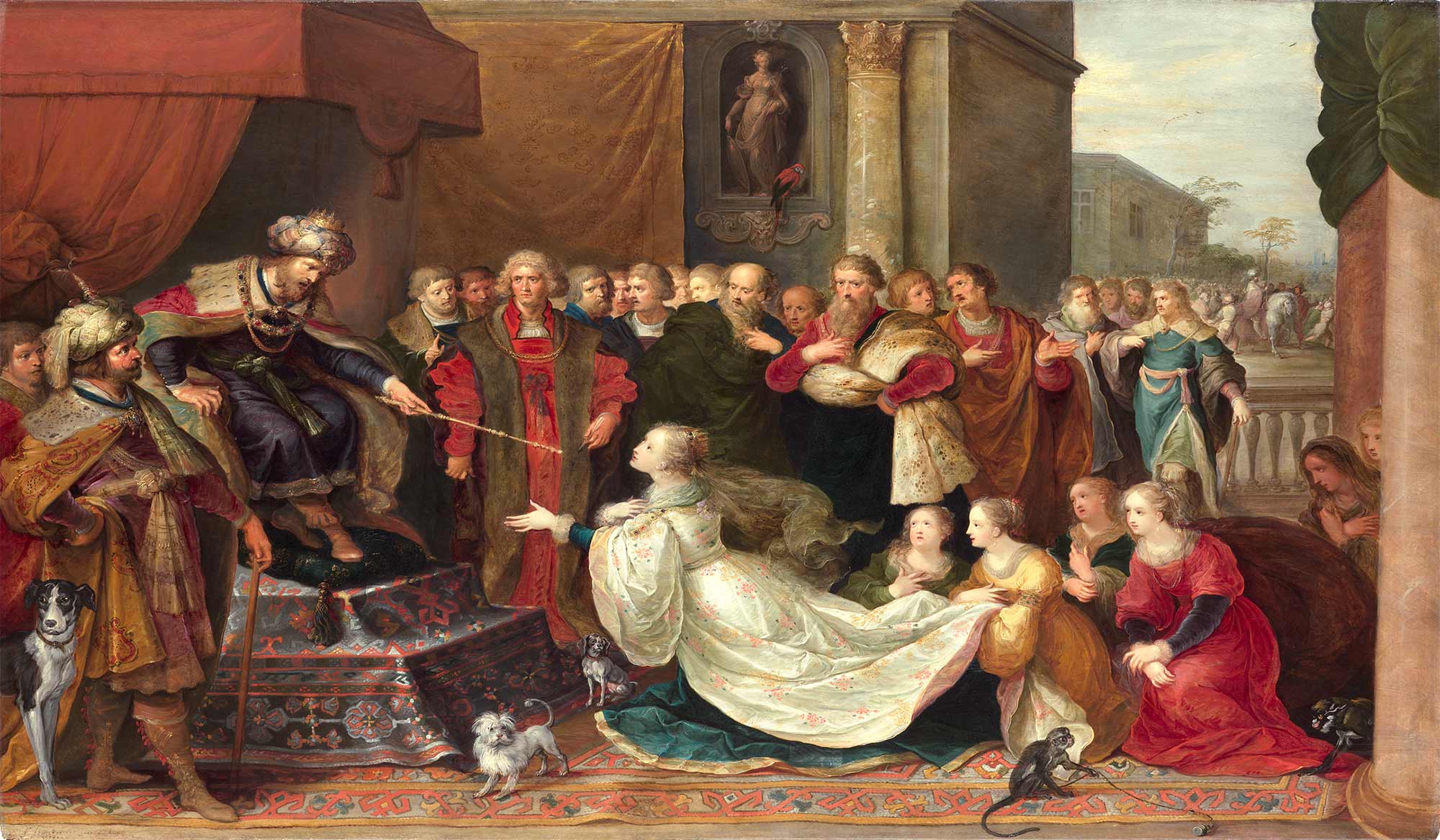
Frans Francken II (1581–1642), Esther Before Ahasuerus, 1622. Oil on panel,
73.5 x 112.8 cm (29 x 44 1/2 in.). The Art Institute of Chicago, in memory of a young boy who delighted in the story of Esther and of all those he loved and who love him, 2025.261.
In this scene, Esther kneels before her husband, requesting a future audience with him so that she might reveal that his vizier, Haman, has issued a decree to slaughter all Jewish people in the empire. Her strategy, guided by her uncle Mordecai (seen on horseback in the distance), is to reveal her own secret Jewish heritage and plead for mercy. Esther is risking her life by seeking audience with the king without invitation, but she bravely overcomes her own fear and, ultimately, delivers the Jewish population. This pivotal moment of courage and resolve is at the heart of the Book of Esther and the feast of Purim.
While Francken’s composition follows the visual tradition established by sixteenth-century Northern prints, the painter inserts background details that reinforce Esther’s celebrated virtues: her eloquence (symbolized by the parrot) and intelligence (symbolized by the statue of Hermathena). The artist adds further luxurious detail by including shell gold in the background curtain and by scratching into Esther’s patterned dress to create dimensionality.
The painting, supported through the generosity of an anonymous benefactor, is on view in the gallery of seventeenth-century Flemish painting.