
After a five-year restoration campaign Quinten Massijs’s monumental Altarpiece of the Joiners’ Guild was reinstalled in the KMSKA. The triptych was commissioned in 1508 by the joiners for their chapel in the Antwerp Church of Our Lady and finished by Massijs in 1511. It depicts the Lamentation of Christ in its central panel and the martyrdom of the patron saints of the guild, John the Baptist and John the Evangelist, in the side wings.
A Turbulent History
Considered as Massijs’s masterpiece since its creation, the Altarpiece of the Joiners’ Guild is one of the best documented works of the Antwerp painter. When we look at its material history, it is a small miracle that the work came down to us. It survived the massive 1533 fire in the church of Our Lady, as well as the Iconoclastic Fury in 1566; attempts by the Spanish King Philip II and the English Queen Elizabeth I to purchase the work in 1577; the art plunderings by the French in 1797; and WWII. During the Calvinist Republic (1577-1585) Maerten de Vos persuaded the city aldermen to buy the work. It was subsequently hung in the city hall between 1582 and 1589, after having been enlarged under the supervision of Michiel Coxcie.
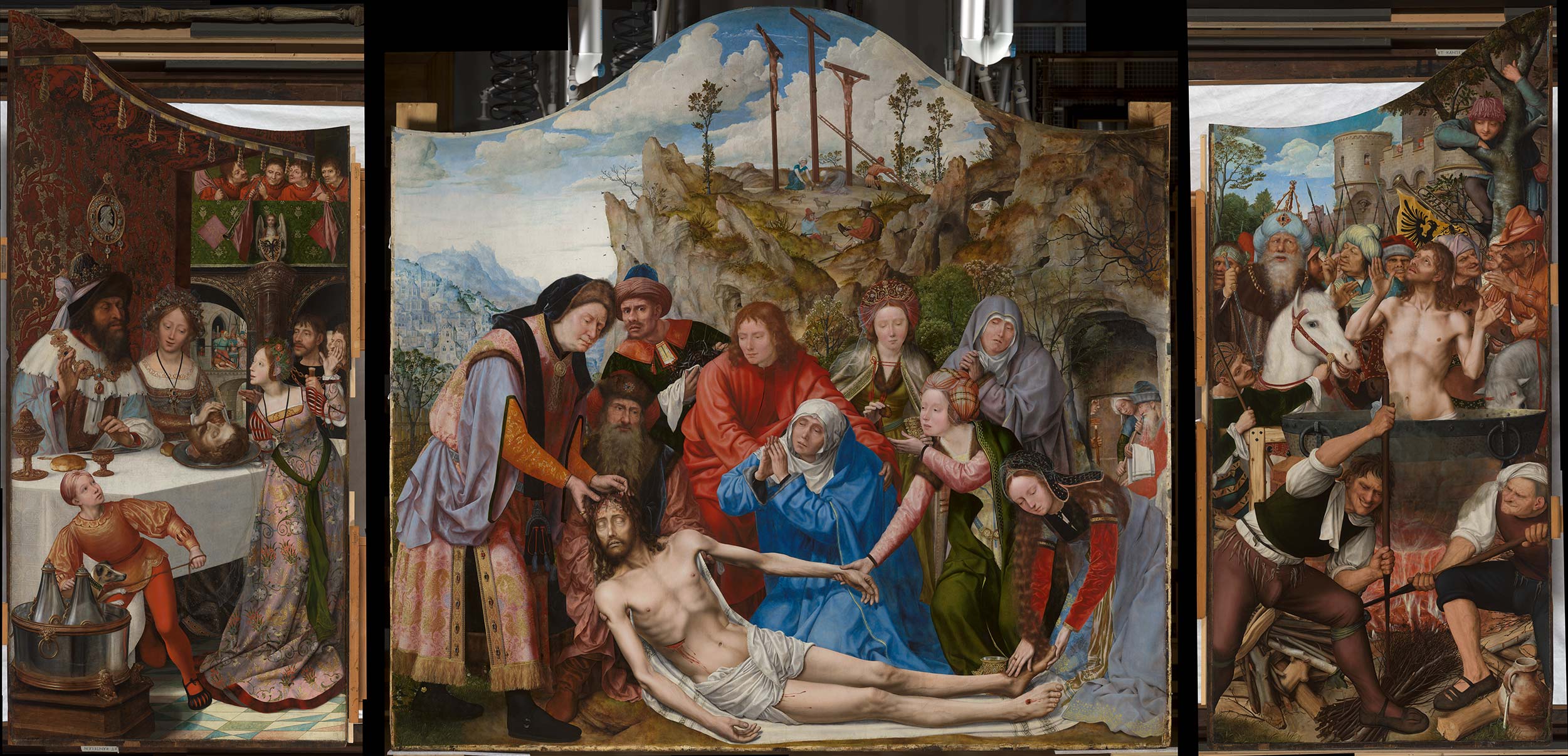
Photo montage showing all three restored panels of the Altarpiece of the Joiners’ Guild.
Previous Treatments
Sources concerning restoration and conservation treatments of the Altarpiece of the Joiners’ Guild are sparse before the middle of the nineteenth century, when it had entered the collections of the Antwerp museum. Between that moment and the middle of the seventeenth century, when Massijs’s first biographer, the painter Alexander van Fornenberg, described its poor condition, it must have undergone at least one overcleaning. This explains why some of the faces, notably those of the three Marys and of John the Evangelist in the central panel, have lost their subtle modelling. The flesh modelling and some draperies, however, still attest fully to the master’s superb mastery of the technique of translucent oil paint that he inherited from his fifteenth-century predecessors, but managed to apply with a remarkable economy of means. Other draperies make full use of opaque details in lead-tin yellow.
The last full treatment of the painting dates back to the beginning of the twentieth century, when most of the historical overpaints and retouchings appear to have been removed. Interventions since then have been limited and reversible: small soluble retouchings, as well as the application of several layers of varnish, and large quantities of wax in an attempt to treat the recurrent flaking of the paint.
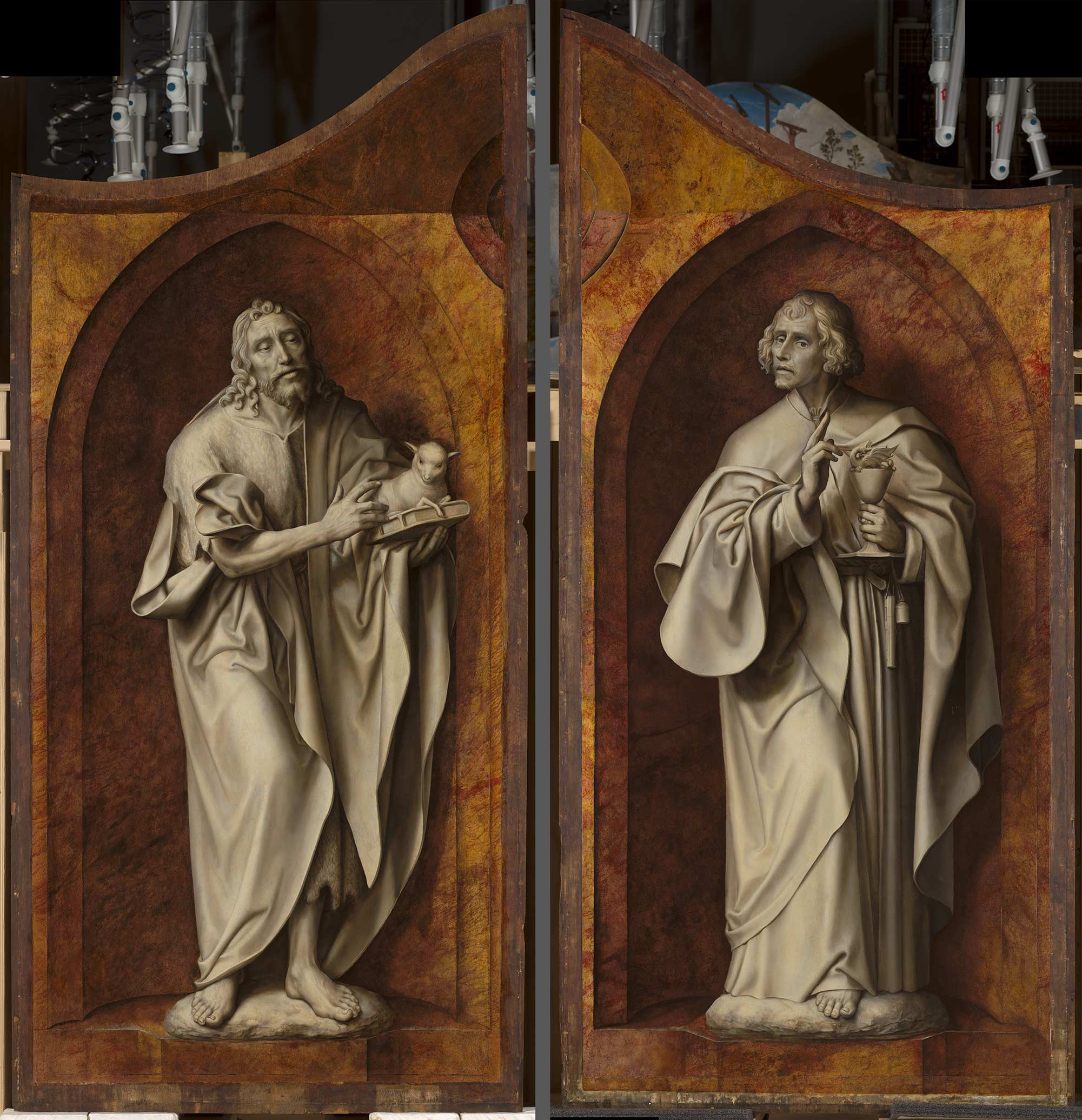
Reverse of the outer panels showing monumental grisailles of patron saints John the Baptist and John the Evangelist.
Recent Restoration Campaign
This campaign has overseen the cleaning of these accumulated layers of varnish and wax residues – and a fair amount of dirt trapped in between –, a thorough consolidation, and the removal of inadequate retouchings. The reverse of the altarpiece wings had not been treated as often as the front. Buried under layers of oxidized varnish, embedded dirt and overpaints, lay two monumental grisailles of the two patron saints in colored stone niches of striking quality.
Massijs Retrospective 2030
The Altarpiece of the Joiners’ Guild will have pride of place in the large Massijs retrospective that the KMSKA is planning for 2030, at the occasion of the 500th anniversary of the death of the artist and the 200th anniversary of Belgium.