
This summer, Museum Prinsenhof Delft acquired an extensive private collection of high-quality Delftware, assembled over a period of 35 years by the Rotterdam businessman Dr. M.C.G. (Gérard) de Bruyn (1893–1964). Purchased with financial support from the Vereniging Rembrandt, the Mondriaan Fonds, and the Stichting van Oosten-Oosterholt, the acquisition represents a significant addition to both the museum and the Collectie Nederland.
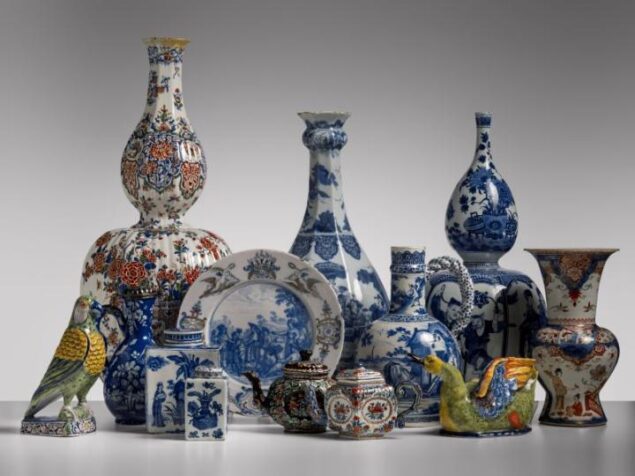
Selection of objects from the De Bruyn Collection (photo: Erik & Petra Hesmerg)
De Bruyn, an importer of marine machinery, systematically collected Delftware until his death in 1964. His collection encompasses works of high artistic quality, ranging from large bottle-shaped vases to colorful animal figures. The collection is particularly notable for numerous pieces decorated with floral branches in blue, green, and red—a decorative scheme known among collectors as cachemire, referring to the colorful cashmere shawls of the era.
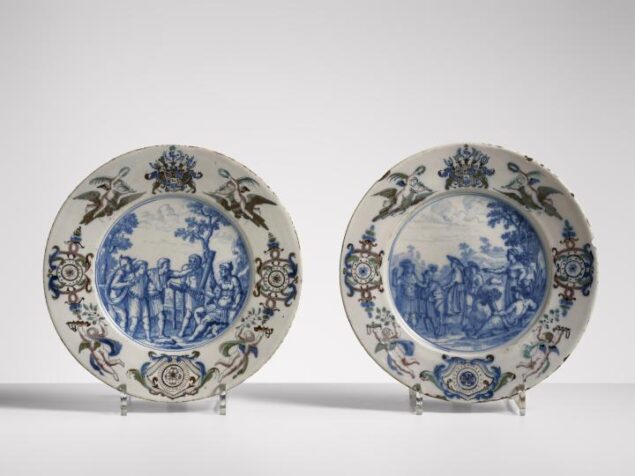
Pair of plates with scenes from the life of Leo X, Het Moriaanshooft (Jannitge Claesdr Hoppesteijn-van Straten), ca. 1680–85
Among the highlights of the collection are two plates produced around 1680 by the Het Moriaanshooft factory for the Dukes of Braunschweig-Lüneburg. Produced during a period when Delftware was favored by the European elite, these plates represent early technical and artistic experiments in combining polychrome decoration with gilding.
Because De Bruyn meticulously maintained purchasing records and documentation on provenance, the collection is exceptionally well documented for a historical ensemble of Delftware. This archival material was acquired alongside the objects and provides valuable primary source material for future research.
Selected works from the De Bruyn collection will be integrated into the museum’s new permanent display alongside historical objects and paintings, as well as featured in a dedicated presentation on the Delftware industry, when Museum Prinsenhof Delft reopens in 2028.