
The Flemish Government gave a recently acquired masterpiece on long-term loan to the Museum Plantin-Moretus in Antwerp. The work, The Triumph of Minerva, is an elaborate preparatory drawing by Jacques Jordaens, dating from around 1660–1665. It stands as an exceptional example of the artist’s talent in his later years. The drawing will be on display at the museum from 9 June to 5 July 2026.
The composition
The composition depicts the triumph of Minerva, the Roman goddess of wisdom and peace. Enthroned at the center, she is honored by the people, while the defeated god of war, Mars, sits at her feet. To the left, Fame sounds her trumpet in celebration. Time, holding a scythe, raises a laurel wreath above Minerva’s head. On the right stands Mercury, identifiable by his staff as the god of commerce. In the lower right corner, a putto (cherub) breaks a bow. The message seems clear: peace and wisdom prevails over senseless violence.
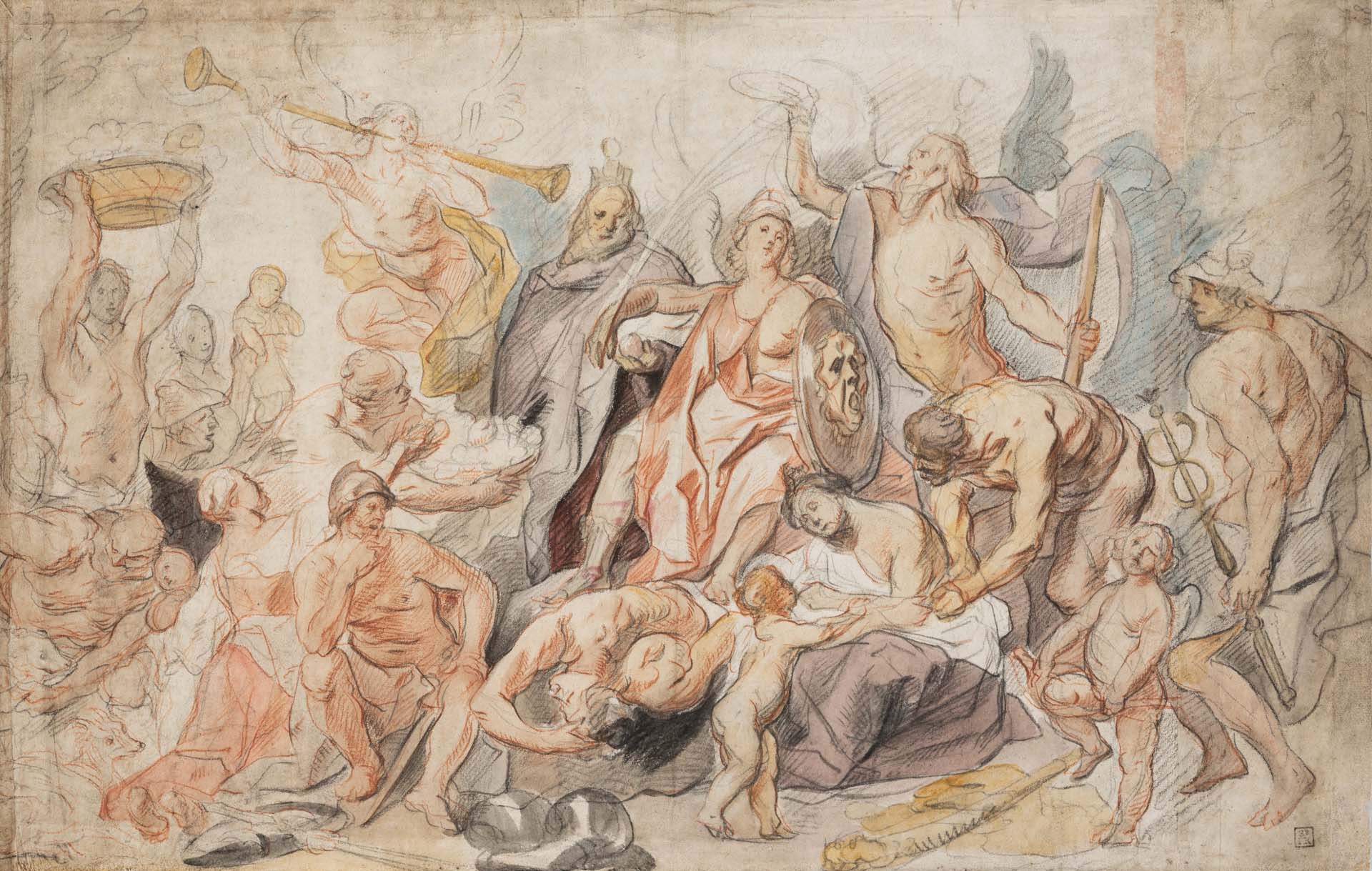
Jacques Jordaens (1593–1678), The Triumph of Minerva, ca. 1660–1665, Museum Plantin-Moretus, Antwerp
A distinguished late work
While many drawings by Jacques Jordaens have survived, The Triumph of Minerva distinguishes itself within his late oeuvre. The work is remarkable for its high quality, as well as its complex and original composition and distinctive allegorical subject matter. Its impressive scale further suggests that it was intended for an important, now-lost painting, possibly one of the works Jordaens donated to the Antwerp Academy on the occasion of its foundation in 1663. Particularly striking are the numerous corrections visible in the drawing, revealing Jordaens’s creative process as he refined the poses of the figures.
Provenance of the drawing
The provenance of the drawing is equally significant. In the eighteenth century, it was owned by Sir Joshua Reynolds, the renowned English portrait painter. In the twentieth century, it was in the collection of Roger D’hulst, a leading authority on Jordaens’s drawings and the author of several key publications on the artist.
Jacques Jordaens (1593–1678), alongside Peter Paul Rubens and Anthony van Dyck, was one of the leading painters in seventeenth-century Antwerp. His career was exceptionally long, and he received commissions from across Europe. Notably, he lived just a street away from the Plantin Press, lending the drawing a sense of having ‘almost’ returned home.