
In 1945, a group of five oil sketches by Rubens in the Ducal Museum in Gotha was split up. Two were taken to Russia, while three entered the American art trade. For more than 80 years, the five artworks remained separated. Now, this extraordinary group of paintings has returned to its rightful place at the Ducal Museum.
A Collection Torn Apart
Shortly before the Red Army took control of the region from American forces in July 1945, the ducal family transported the most valuable works from the Ducal Museum to Coburg as a “temporary protective measure.” Only a few have since returned. Although the artworks had belonged to an independent Gotha art foundation since 1928, several were unlawfully sold and ended up in private collections, museums, and on the art market. Among them were three of the five Rubens sketches.
Simultaneously, the Red Army’s Trophy Commission transported several railway carriages full of paintings from Gotha to the Soviet Union, in breach of international law. Only a fraction were ever returned, including two Rubens sketches restituted to the GDR in 1958 and displayed in Gotha since 1959.
As a result, the historic group of five Rubens sketches—assembled since the early 18th century—remained scattered. While two works were back in Gotha, three had found new owners through the American art trade.
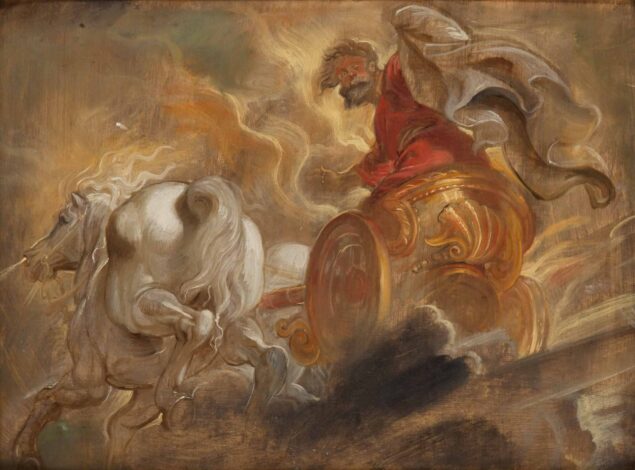
Peter Paul Rubens (1577-1640), Rubens The Prophet Elijah in the Golden Chariot, 1620/21
Schloss Friedenstein, Gotha
The Return
In 2024, with the assistance of Christie’s auction house, Saint Gregory of Nazianzus was returned by the Buffalo AKG Art Museum. Now, two years later, the Ducal Museum celebrates the return of another work: The Prophet Elijah in the Golden Chariot. Historically, this was the first of the five oil sketches acquired for the ducal painting collection by Duke Frederick II of Saxe-Gotha-Altenburg (1676–1732). After 1945, it had ended up in a private American collection. The Paris auction house Cabinet Turquin aided in negotiating the painting’s return, while the Ernst von Siemens Art Foundation supported the acquisition financially.
At the same time, an agreement was reached with the Foundation E.G. Bührle Collection to loan Saint Augustine—the final missing sketch from the original ensemble—for the presentation.
Jesuit Church
Rubens created these 1620 oil sketches as designs for the 39 saint depictions on the ceiling of Antwerp’s Jesuit church of Sint-Carolus Borromeus. Today, these oil sketches hold exceptional significance, as the original ceiling paintings were destroyed by fire in 1718.
The presentation is on view at the Ducal Museum in Gotha until 9 May 2027.