
Pieter de Hooch’s Courtyard with a Smoking Man and a Drinking Woman (ca. 1658–60) is temporarily on display in Room 15 of the Mauritshuis. The painting depicts a smoking man, a drinking woman, and a child in the kind of Dutch courtyard scene so characteristic of the Delft master. Originally, however, De Hooch painted a third figure seated between the man and the woman: a soldier in armor holding a tankard of beer. At some point over the centuries, he disappeared from the composition. During the painting’s recent restoration, the Mauritshuis faced a dilemma over how to deal with this missing figure. After extensive research and careful consideration, the museum decided to largely reinstate the soldier.
-
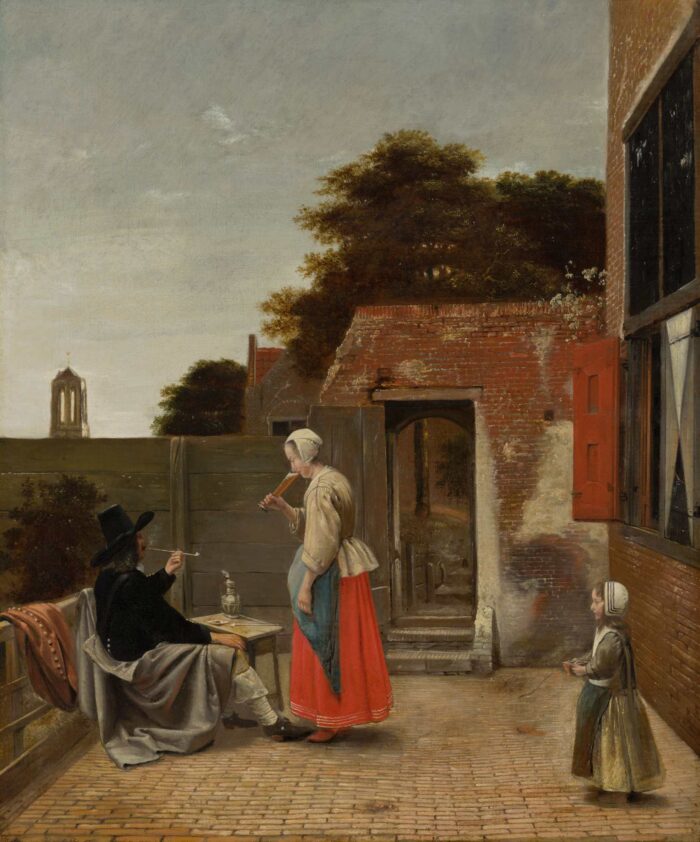
- The Mauritshuis painting before restoration
-
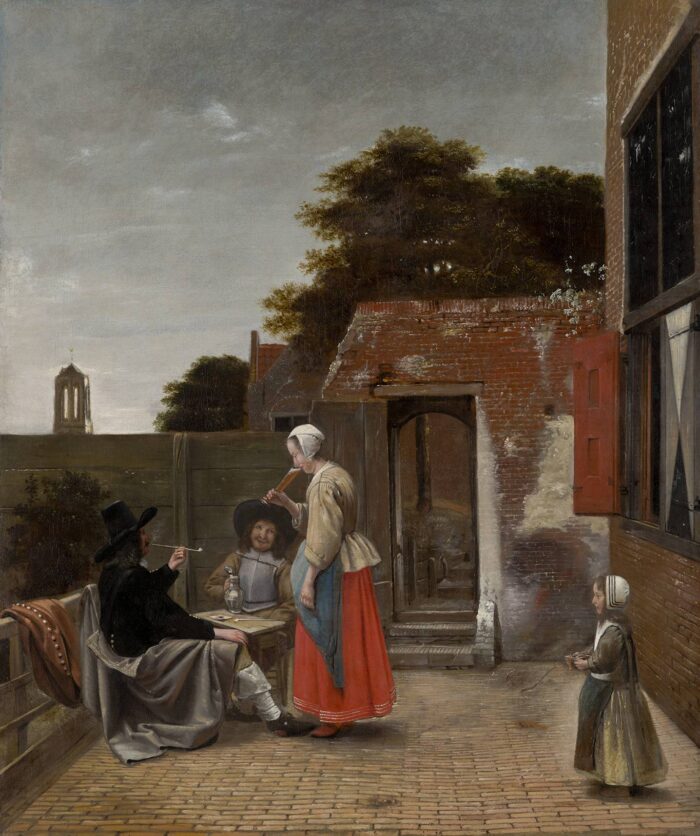
- The Mauritshuis painting after restoration
A Drinking Game
The Mauritshuis was able to reconstruct what the soldier originally looked like because De Hooch painted the exact same scene during the same period. That version, now in the National Gallery of Art in Washington, D.C., is titled A Dutch Courtyard (ca. 1658–60). There, the soldier can be seen smiling at the woman as she raises a glass to her lips. The men are challenging her to a drinking game. We know this because she is drinking from a pasglas—a marked drinking glass that required the drinker to continue until reaching the next line. Without the soldier, the Hague painting became a very different scene: a man and a woman who appear to be taking a quiet break together.
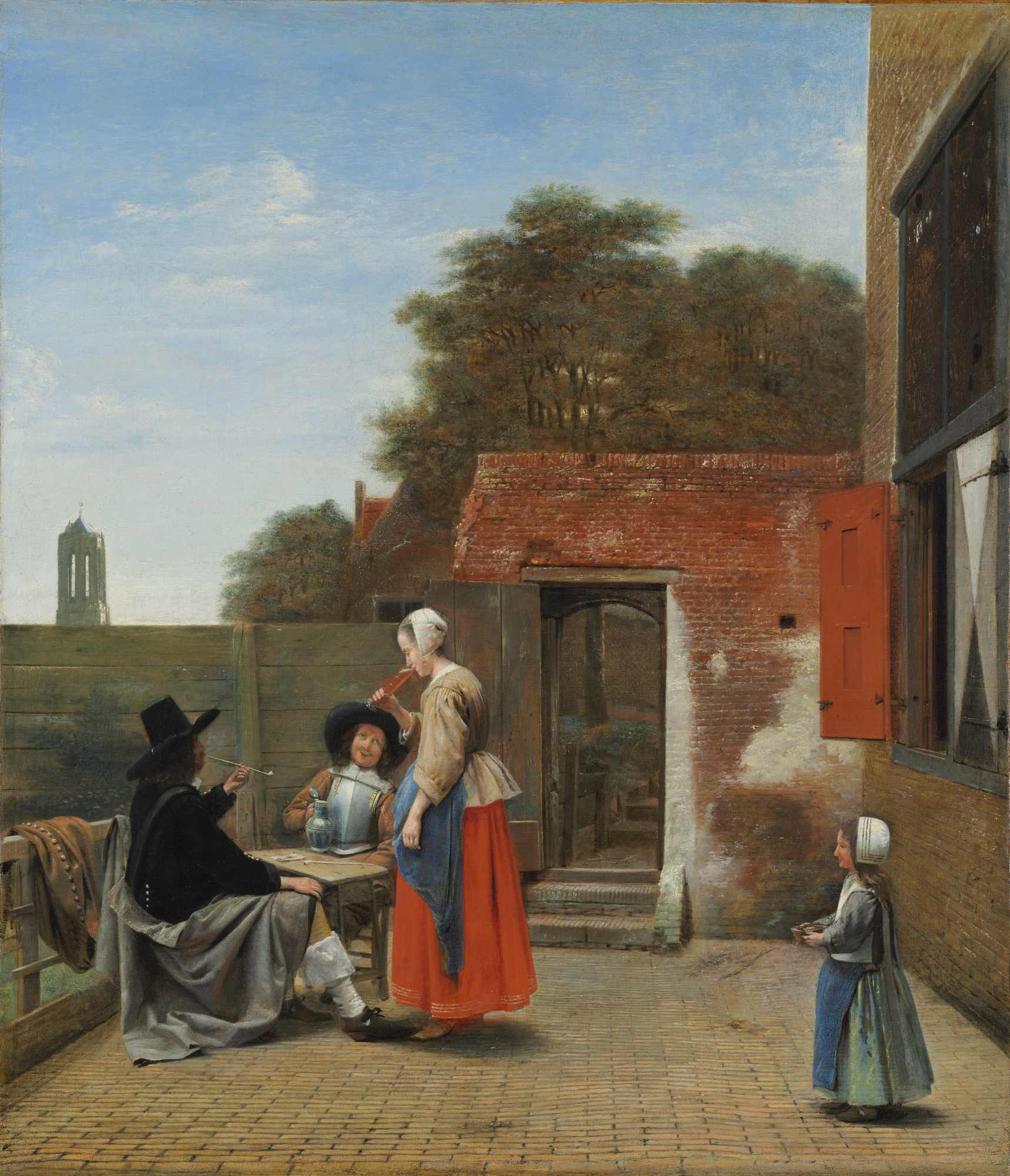
The painting with the same composition in the National Gallery of Art, Washington
The Orphaned Beer Tankard
The presence of a third figure at the table has been known since the 1920s, when the renowned restorer Martin de Wild worked on the painting. He uncovered the soldier, photographed him in black and white, and then painted over the surviving remains. As a result, the composition remained somewhat puzzling. Since entering the Mauritshuis collection in 1947, the painting has continued to contain traces of the missing figure: the soldier’s pipe and open beer tankard remain on the table, while his cloak still hangs over a gate.
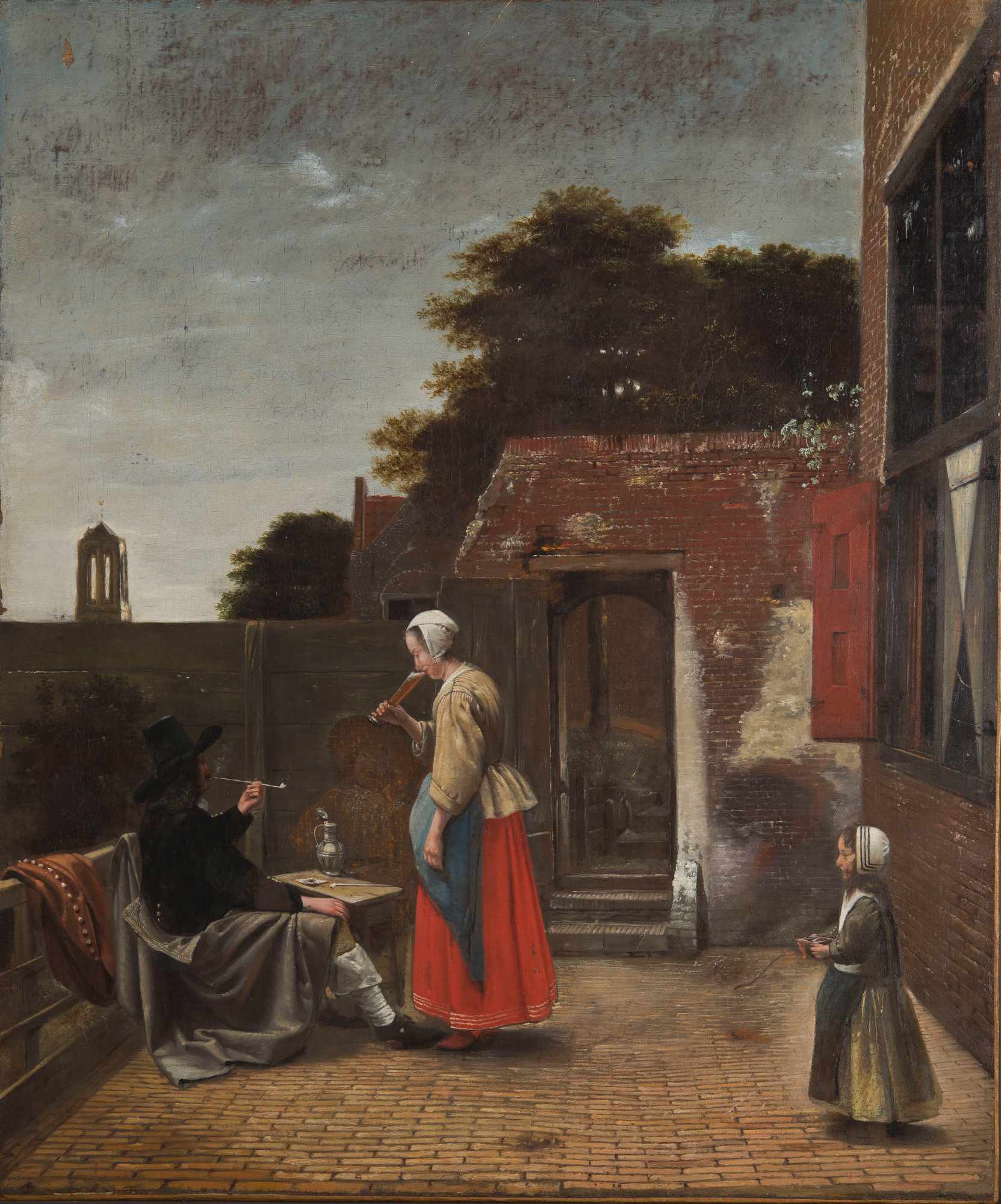
The Mauritshuis painting during restoration
The Mysteries Remain
The painting nevertheless continues to raise questions: who removed the soldier, and why? It is certain that De Hooch painted two nearly identical versions of the composition, something that was not unusual in the seventeenth century. It is equally certain that De Hooch himself did not paint over the soldier. What we do know is that by approximately 180 years later, he was already absent from the scene. In 1833, the painting appeared in a catalogue of the John Smith Gallery in London and was described without any mention of the soldier. Since the gallery had owned the painting since 1822, we can conclude that the figure was removed sometime between around 1660 and the early nineteenth century.
Extensive technical research, including Macro-XRF (macro X-ray fluorescence spectroscopy) carried out with the Rijksmuseum, has not been able to answer the questions of who removed the soldier, when this happened, or why.
The painting will remain on view in Room 15 of the Mauritshuis until the museum’s temporary closure (24 August–20 September). It will then travel to Madrid for the exhibition Mauritshuis ♥ Thyssen-Bornemisza.