
Earlier this year, Joseph and Jana Roussel, CODART Patrons since 2017, decided to perpetuate their support by becoming Patrons for Life. This struck us as the perfect opportunity to chat with them about collecting in general and, more specifically, collecting Old Masters. During a lively session, they described how their collection took shape, discussed the joys and challenges of collecting and offered some useful tips for young collectors.
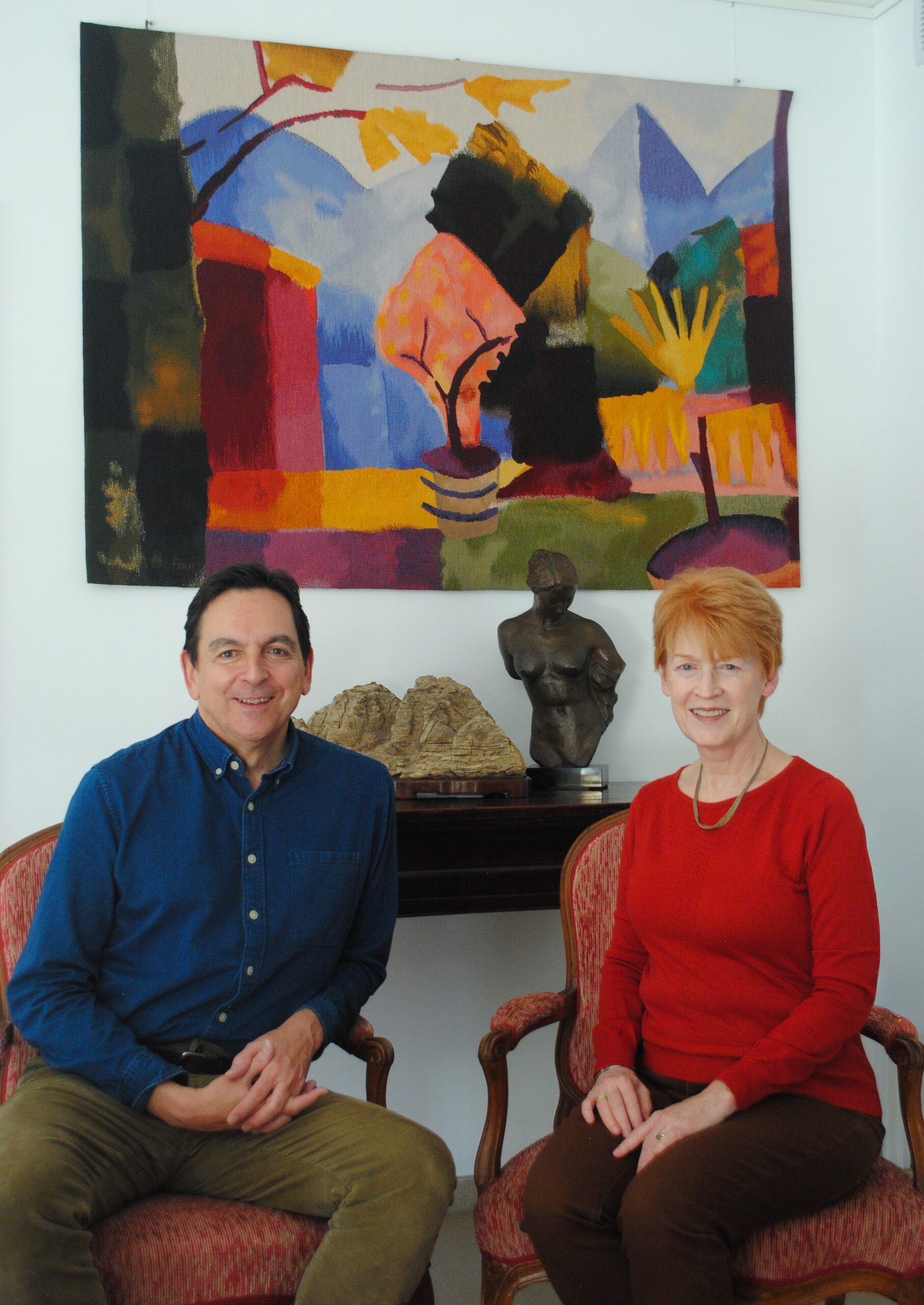
Joseph and Jana Roussel, November 2025
Photo: Olivia MacLeod
Could you tell us a little about your collection?
“Eclectic” is the best word to describe our collection which includes Old Masters, Chinese scholars rocks and calligraphy, twentieth century French sculpture, and nineteenth and early twentieth century French pastels. Our Old Masters collection focuses primarily on seventeenth century Dutch and Flemish artists, although we do have pieces from the early 1500s. These works encompass paintings, drawings, and engravings covering subjects such as portraits, religious works, landscapes, and mythology.
What sparked your interest in art?
Our collecting interests have largely been shaped by the places where we’ve lived. For instance, our interest in French sculpture arose during our 28 years in Paris where we were surrounded by public sculpture. Living in Belgium, we encountered outstanding seventeenth century art, architecture and history, so our interest in Flemish art was a natural outgrowth of that. While we haven’t lived in China, Joseph’s lifelong interest in Chinese painting and calligraphy and travel to China sparked that interest. And Jana’s interest in Belle Epoque Paris led to collecting early twentieth century French pastels. The Old Masters collection is definitely a joint interest.
How, when and why did you start collecting Old Masters?
We didn’t start out with a plan. In 2012 we stumbled upon an early sixteenth century painting at an art fair in Paris. In a watershed moment, we looked at each other and said, “Is there any reason why we shouldn’t take this home with us?” Although we already had some contemporary art in our home, until then it had never really occurred to us that “ordinary” people could own Old Masters; we thought they were only in museums or accessible exclusively to people with enormous wealth. After that first purchase, with no real notion of building a collection, we simply started acquiring other pieces. Not having connections to other collectors or experts at that time, we learned as we went along.
How do you decide what to collect? What is the main motivation behind your collection?
We don’t have a “shopping list” of things we want to add to our collection. Of course there is the initial “wow factor,” but our main motivation for acquiring works is to be surrounded by art that inspires us with creativity and originality and intrigues us through the stories it tells.
Each of our Old Masters tells a story. It could be how an artist’s travels to various cities influenced their style over time, or what the choice of, say, a pheasant instead of a turkey meant in a painting commemorating a wedding. Portraits are often the most compelling natural storytellers. For instance, one of our paintings is a study of someone who reappears in a group portrait of the governors of the Amsterdam orphanage. But our research revealed more to this man than just his engaging smile. We discovered that the subject, who was also the person assigned the job of choosing the artist for the group portrait, lived next door to the artist’s brother. We can vividly imagine the brother angling to get his sibling the commission for the group portrait (and he did!). These are stories anybody can relate to and that are still relevant today. We love these tangible links to the past.
Likewise, religious works are fascinating because of the mysteries of iconography. We recently learned about a research project on secret imagery in Netherlandish painting regarding not only the objects depicted but how they are positioned. It’s intriguing that people were using art back in the 1600s to communicate messages, often in a hidden way because of the Catholic-Protestant conflict.

Abraham de Vries (1590-1649/1650), Portrait of an unknown man in black, 1643
Is this also what attracts you the most about the Old Masters, that they bring such interesting stories?
The stories they tell about their makers and patrons are intriguing, fun and sometimes challenging, but what is equally important is the outstanding level of the artist’s technical skill. We figure that’s why there’s the word “master” in Old Masters.
What do you enjoy most about collecting?
Learning about the objects is clearly one of our favorite things, as mentioned earlier. Also, we enjoy stimulating conversations with other collectors and dealers, curators, and academics. Supporting art history research is an endeavor we particularly enjoy. For example, we commissioned research into the identity of the artist of one of our paintings and discovered to our delight that we already had another of his works in our collection. That is absolutely thrilling, rather like being a detective as well as an art lover. Another example: we came across an engraving in the Rijksmuseum based on one of our portraits, so we commissioned a graduate student in Ghent to conduct a research project. Digging in archives across Belgium, she was able to determine a previous owner and take the provenance back to the mid-eighteenth century. We were excited not only to find out more about our painting but to be able to support this student whose report is now in major research centers in Belgium and the Netherlands.
Finding out more about the provenance and previous owners is also fulfilling. Why did others collect this piece, and why did they sell it? One ends up going through world history with these pictures because they’ve traveled so much.
Going back to what we said earlier, we really believe every work has a story, and we love uncovering these and sharing them with others. And above all, we want to demystify art, because too many people are afraid of art. They are especially wary of Old Masters because it’s so far in the past. Making art relatable to people who may not initially be interested is one of our passions. That applies to any area of art, but guess what? Old Masters have more stories because they’re old! It’s like with older people – they have a lot more stories than young ones.
And what is the least enjoyable part?
Trying to get provenance information from dealers and auction houses. For example, we have a painting that we would like to donate to a museum, but they won’t accept it until we can provide the full provenance. Large portions of its history, notably its time in the 1930-40s, were not provided when we acquired it, so Joseph is researching this himself. We’re not concerned that the provenance itself is problematic, but in today’s world, a work of art is “guilty” until its provenance is complete. The art world needs a better way of dealing with this issue, a middle ground between ignoring provenance issues and exiling pictures to Siberia when they don’t have full documentation. Despite these issues, fully documenting works of art, where they come from, who owned them, and what happened to them is something all collectors need to embrace as “responsible” collectors.
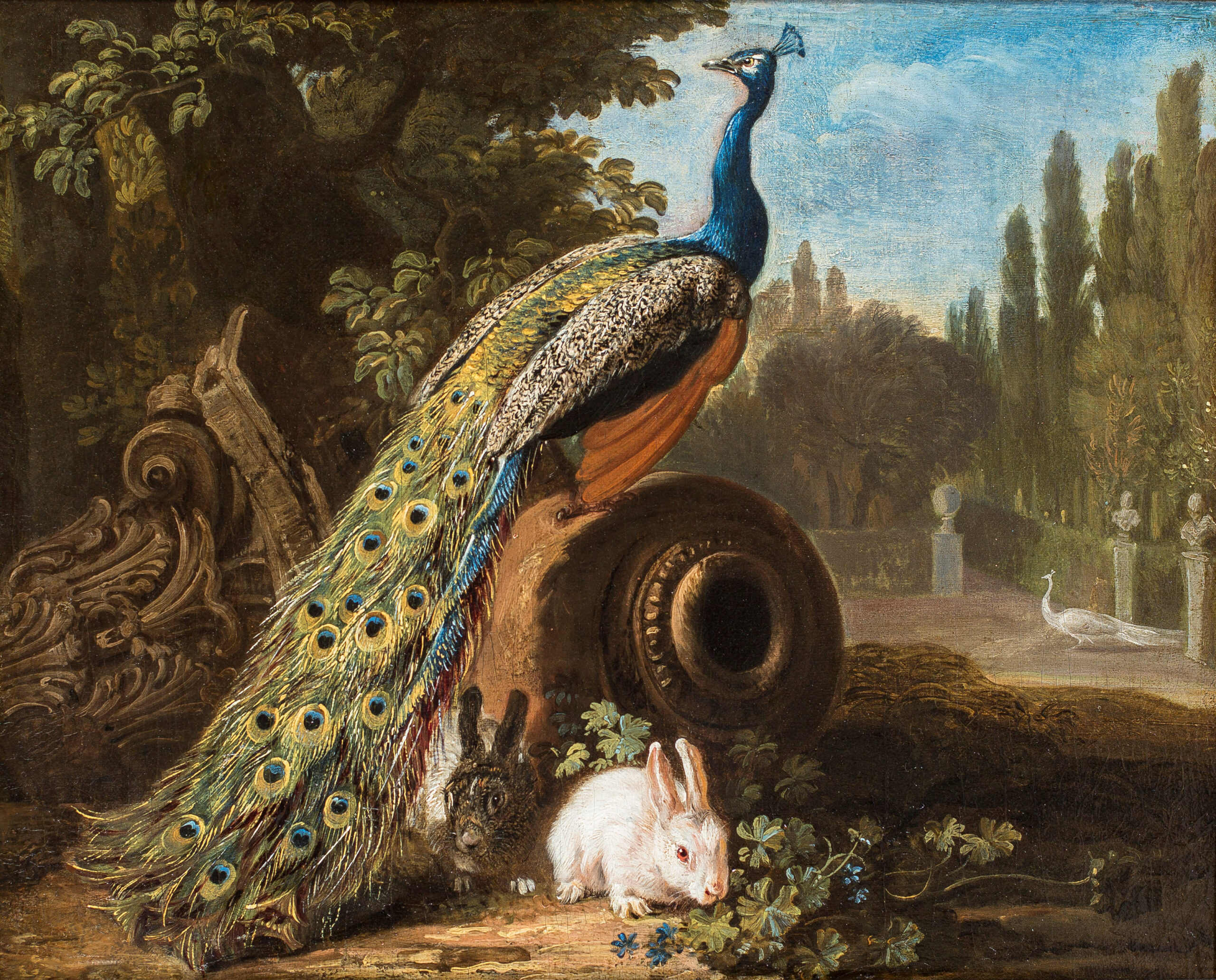
David de Coninck (1643-1703), Peacock and rabbits, ca. 1680s
Is there anything on your wish list?
We don’t have a specific shopping list; discoveries will come in their own time. However, we would like to see more experience and knowledge sharing among collectors on practical issues. Thankfully there is CODART, the only forum we have found where we can go to have discussions with other collectors on this topic.
Some key areas that could benefit from sharing among collectors include best practices for conducting condition analysis, cataloguing collections and provenance research. We spend time working with laboratories on condition and dating analysis and have noted a wide range of standards applied. It would be good to hear from other collectors about their experiences. As for cataloguing and provenance research, we’d love to get people’s advice on best practices—what kind of information they collect, where they find it, where they store it, and whether they recommend using electronic platforms. For most collectors, it’s a learn-as-you-go kind of thing for these areas.
Do you have any advice for young collectors?
- Don’t be afraid but do set a budget.
- Spend time in museums, galleries and auctions to train your eye.
- Become familiar with condition issues and provenance – these are an integral part of owning a work.
- Buy the best quality you can afford. It’s better to buy a fabulous work by a lesser-known artist than a weak work by a well-known artist.
- Lastly, we want to encourage people to know that one doesn’t have to be well-off to develop a meaningful collection. It is totally possible for any person on any budget.
Why did you decide to join CODART as Patrons?
Understanding art from the past can bring new, much needed, perspectives to people today. We joined CODART because curators have a critical role in promoting Dutch and Flemish art and making it relevant to today’s audiences. CODART programming also supports important topics like provenance research and develops the network for curators by facilitating a global community. Curators have such an important voice, and we believe CODART is right on track with the topics it addresses. This is important work, and we want to support it.
Would you like to learn more about the Friends of CODART and how you can support CODART’s mission? Visit www.codart.nl/friends.