
Almost referring to a Holy Family on their way into Egypt: travelers in a southern/Italianate landscape, passing a herdsman with sheep resting. In the distance, a river (referring to the Oude Maas) with the appearance of Dordrecht’s Onze-Lieve-Vrouwekerk, Dordrecht being the native city of Aelbert Cuyp (1620–1691). Distant views of Dordrecht often appear in his paintings and drawings. Cuyp never went to Italy, but he emulated Dutch Italianate painters who had been there, above all Jan Both (1615/18–1652). He belongs to a family of painters in Dordrecht and is one of the leading artists of the Golden Age. He is especially known for his views of Dutch riverside scenes, often in an early morning or late afternoon light. His father (and teacher), Jacob Gerritsz. Cuyp (1594–1652), was a well-known portrait and landscape painter. Belonging to the same family was Benjamin Cuyp (1612–1652), also a pupil of Jacob and much influenced by Rembrandt.
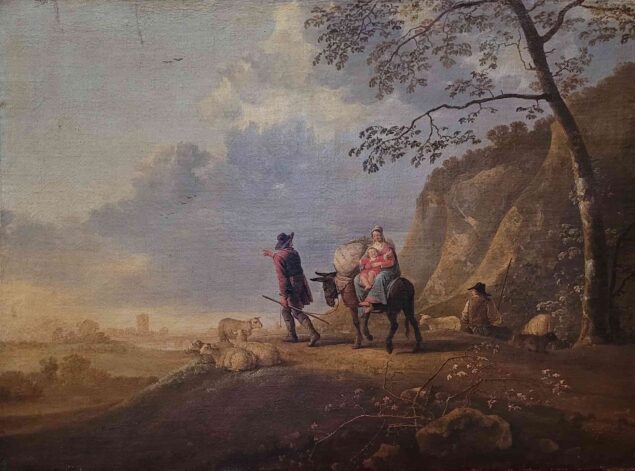
Aelbert Cuyp (1620-1691), Landscape with Travelers and a Distant View of Dordrecht, Private collection
Aelbert seems to be the most famous member of the family, and his paintings found their way into the most important museums in Europe and the US. Little is known about his life, and he was generally active between 1640 and 1665. It seems that the end of his productivity was connected to his marriage in 1658 to Cornelia Bosman. From that time on, he became a devout Calvinist (and a deacon of the reformed church), and the number of paintings produced by him declined almost to nothing.
Around 1640, he clearly came under the influence of the style of landscape painter Jan van Goyen (1596–1656), and around 1645, the influence of Jan Both took over. Finally, he was influenced by his father, Jacob, and started making animals the focus of his paintings. Cuyp signed many of his works (as in the case of this painting) but rarely dated them. Some paintings attributed to him are initialed A.C., but these could also refer to his follower Abraham van Calraet (1642–1722).
A late-afternoon impression based on studies made in nature—and therefore an example of Cuyp’s “luminous style”—suggests that this painting can be dated to about 1655–1660. Regarding the theme of the Flight into Egypt mentioned above, the Metropolitan Museum of Art in New York owns a Landscape with the Flight into Egypt (oil on wood, 45.7 × 58.1 cm, ca. 1650) by Aelbert Cuyp.
The painting presented here (81.5 x 110 cm and on a canvas that has never been relined) came to light only recently.