
This summer, the Provincial Museum of Ancient Arts in Namur (Belgium) invites you to immerse yourself in the fascinating world of Cornelis Cort.
The exhibition, curated by Prof. Dominique Allart, Prof. Antonio Geremicca and Dr. Gaylen Vankan, presents more than 50 engravings by the Dutch master, all from the rich graphic collection of the Wittert Museum (University of Liège), alongside one of his rare autograph drawings (Royal Library of Belgium) and the only known painted portrait of the artist (Vienna, Kunsthistorisches Museum).
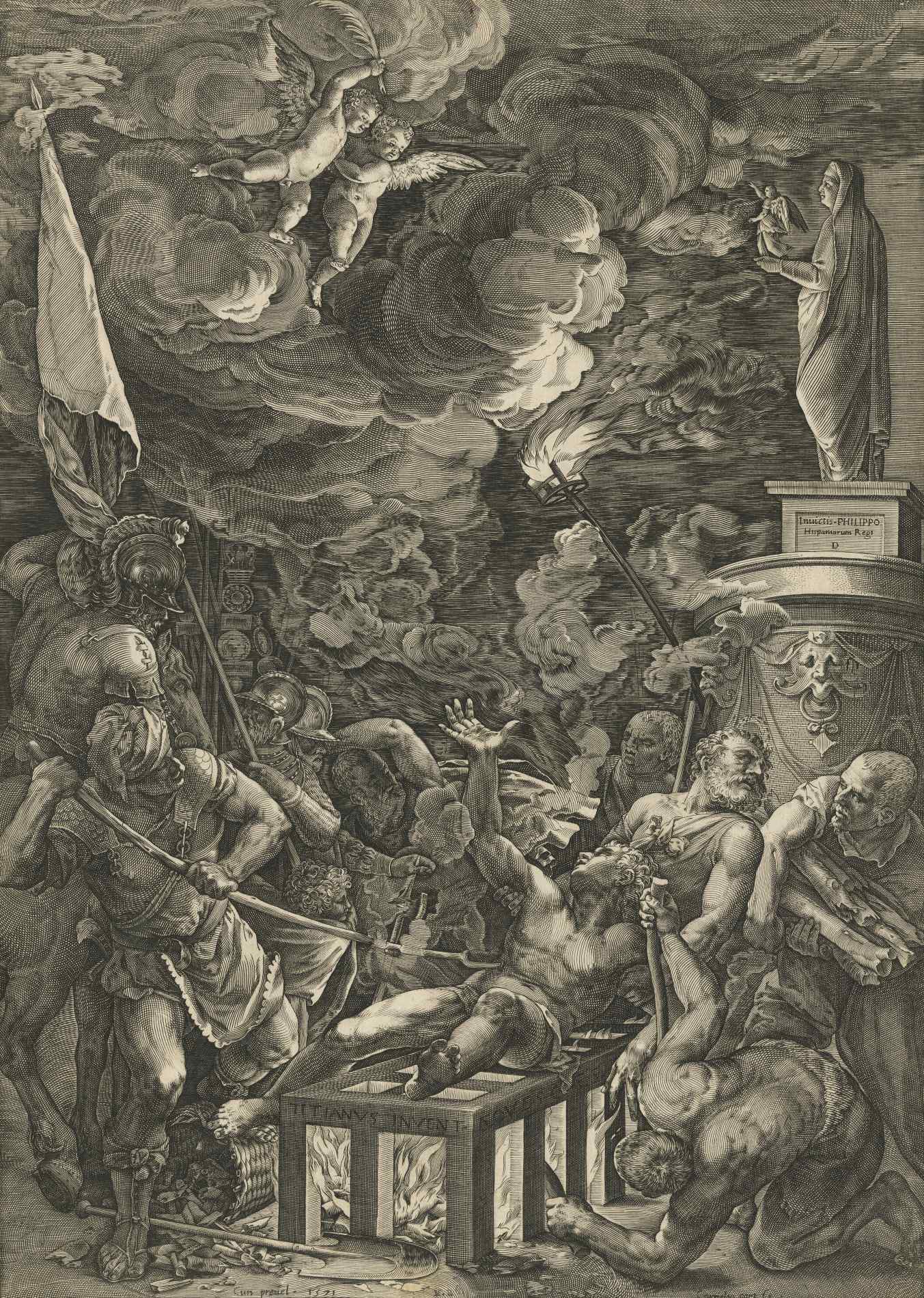
Cornelis Cort (1530-1578) after Titian, The Martyrdom of Saint Lawrence, 1571, Wittert Museum
Born in Hoorn around 1533–1536, Cornelis Cort made his debut on the Antwerp art scene, placing his talents as an engraver in the service of the prestigious publishing house “In the Four Winds,” founded and run by Hieronymus Cock and his wife. There, he translated onto copper the inventiones of leading artists such as Frans Floris and Maarten van Heemskerck.
In 1565 Cort moved to Italy where he enjoyed a flourishing career. He first worked in Venice, where his engravings played a crucial role in the dissemination and growing influence of Titian’s work. He then settled in Rome, collaborating with some of the greatest artists of the High Renaissance, including Federico Zuccaro, Giulio Clovio, and Girolamo Muziano. His activity at the Medici court in grand-ducal Florence will also be explored.
Cornelis Cort died in Rome in 1578. Although he left behind only a few modest possessions, he left posterity with the memory of having been one of the greatest engravers of his generation.
Such a monographic exhibition is the first since 1994, when the Museum Boijmans Van Beuningen in Rotterdam organized one. Through the works of the Dutch master, it aims more broadly to highlight how printmaking revolutionized artistic practices, allowing images to be widely disseminated throughout Europe and even beyond.
The exhibition is available in French, English, and Dutch. A scholarly publication featuring nine essays and a catalogue of the works on display will accompany the exhibition.