
What happens when you depict words and phrases literally? Today we recognize this technique from cartoons and memes, but the phenomenon is much older. Pieter Bruegel, in particular, became famous for his depictions of idioms and proverbs. They are often funny and absurd, yet at the same time enigmatic and sometimes also a touch provocative. They rank among Bruegel’s most beloved and influential works.
Folly beyond Words is the first large-scale exhibition dedicated to the role of proverbs and figurative language as a source of inspiration in the visual arts. The focus is on Bruegel’s work and the decade he spent working in Antwerp. The exhibition also explores how some of the greatest painters of the 17th century, such as Rubens, Michaelina Wautier, Jacques Jordaens and Jan Steen, continued to depict proverbs. Simultaneously, visitors can explore how this practice also featured in non-European artistic traditions. Selected examples, from pottery from Iran and China to prints from Japan, reveal striking parallels to the Bruegelian tradition.
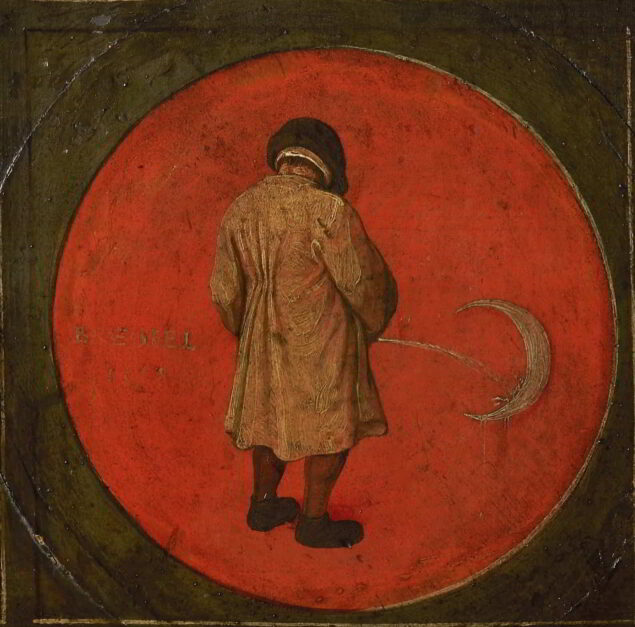
Pieter Bruegel (ca. 1525/30 – 1569). Twelve Proverbs (detail), 1558
Museum Mayer van den Bergh, Antwerp
By speaking through images, artists sought to make people think and, above all, to get them talking. These images were conversation pieces. Behind the humor and the everyday wisdom often lie very sensitive subjects. These works thus offer a unique insight into the issues that preoccupied people in the 16th and 17th centuries: social inequality, corruption, alcohol abuse, the upbringing of children and the fragility of life. It is precisely this relatability that means they can still strike a chord and move us today.
This exhibition brings together about thirty works by or after Pieter Bruegel the Elder. It places them in dialogue with paintings, drawings, prints, and decorative works of art from the sixteenth- and seventeenth-century Low Countries and far beyond that testify to a similar fascination with proverbs. In doing so, Folly beyond Words reveals an important but remarkably little-known source of inspiration for early modern Netherlandish art: figurative language.
The exhibition is curated by Dr. Samuel Mareel.