
Texture presents Tablescapes, an exhibition featuring a selection of napkins and tablecloths from its historic damask collection alongside contemporary works by master folder Joan Sallas and textile designer Emilie Palle Holm. The display explores the artistry of the decorated table, a tradition that flourished in Europe during the sixteenth, seventeenth, and eighteenth centuries.
The Rise of Damask in the Low Countries
While the technique of damask weaving originated in Asia and reached Europe via the Silk Road, the Low Countries became a preeminent center for its production. Kortrijk was particularly renowned for its skilled linen weavers. Following the religious and economic upheavals of the late sixteenth century, many weavers from the Southern Netherlands migrated north. A significant number settled in Haarlem, a city with a thriving textile and bleaching industry. Haarlem subsequently evolved into a major hub for damask production and the linen trade, supported by influential figures such as the Kortrijk-born weaver Passchier Lammertijn.
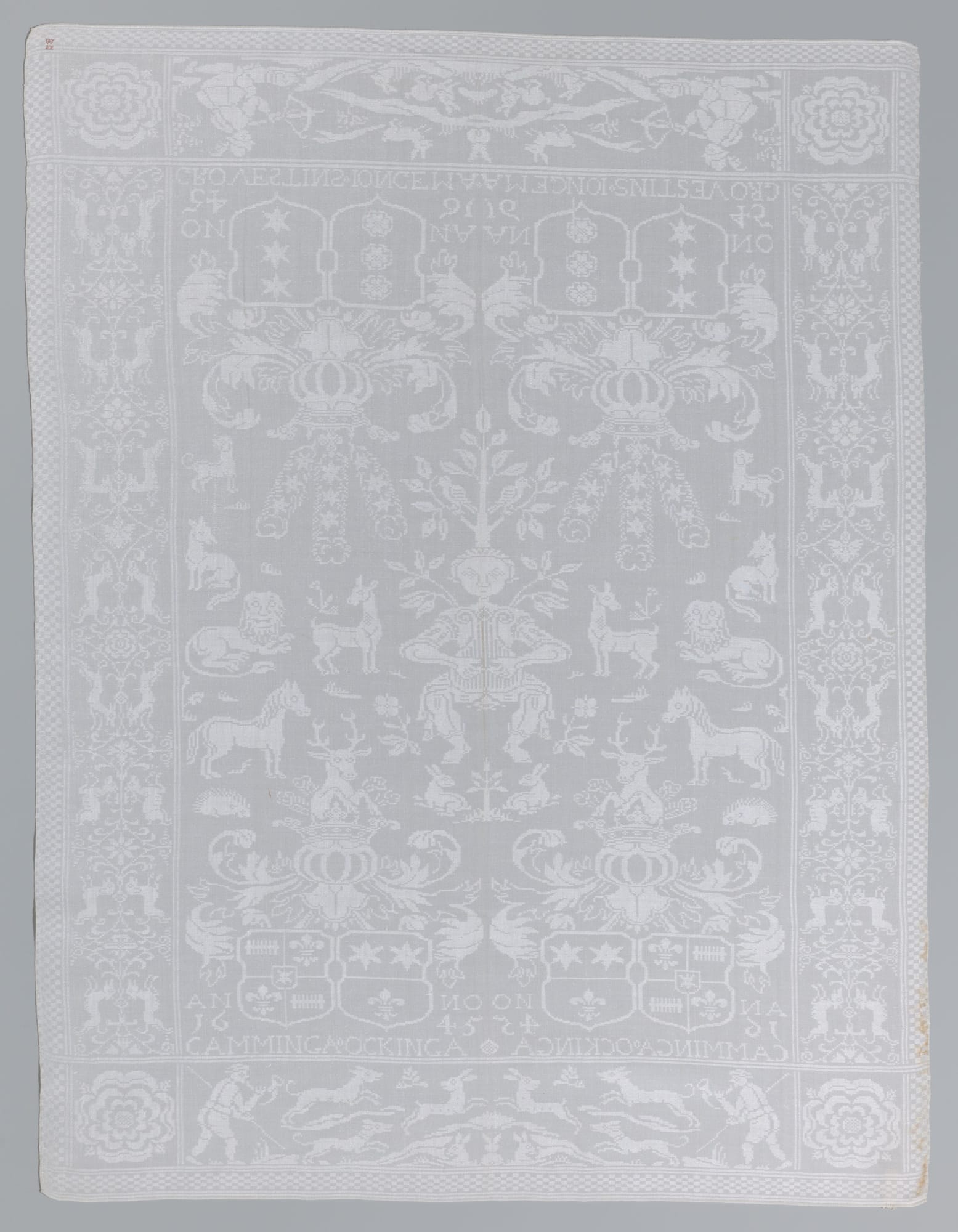
Haarlem, Napkin with Orpheus and Coats of Arms of the Families Camminga-Ockinga and Grovestins-Jongema, 1645
Texture, Kortrijk
Damask woven in the Low Countries was highly sought after by European royal courts and wealthy burghers. These exquisite textiles were often commissioned to commemorate weddings or military victories, serving as prestigious gifts or “conversation pieces” at the dinner table. In the Low Countries, the sharp folds of crisp linen were regarded as a clear sign of prosperity.
The Tradition of Linen Sculpting
During the sixteenth century, a new fashion emerged at North Italian courts: the folding of linen into elaborate, three-dimensional sculptures. These techniques spread rapidly across Europe through instructional manuals, most notably Li tre trattati by Mattia Giegher (1629). These “table triumphs” transformed simple napkins into heraldic animals, floral arrangements, and architectural forms.
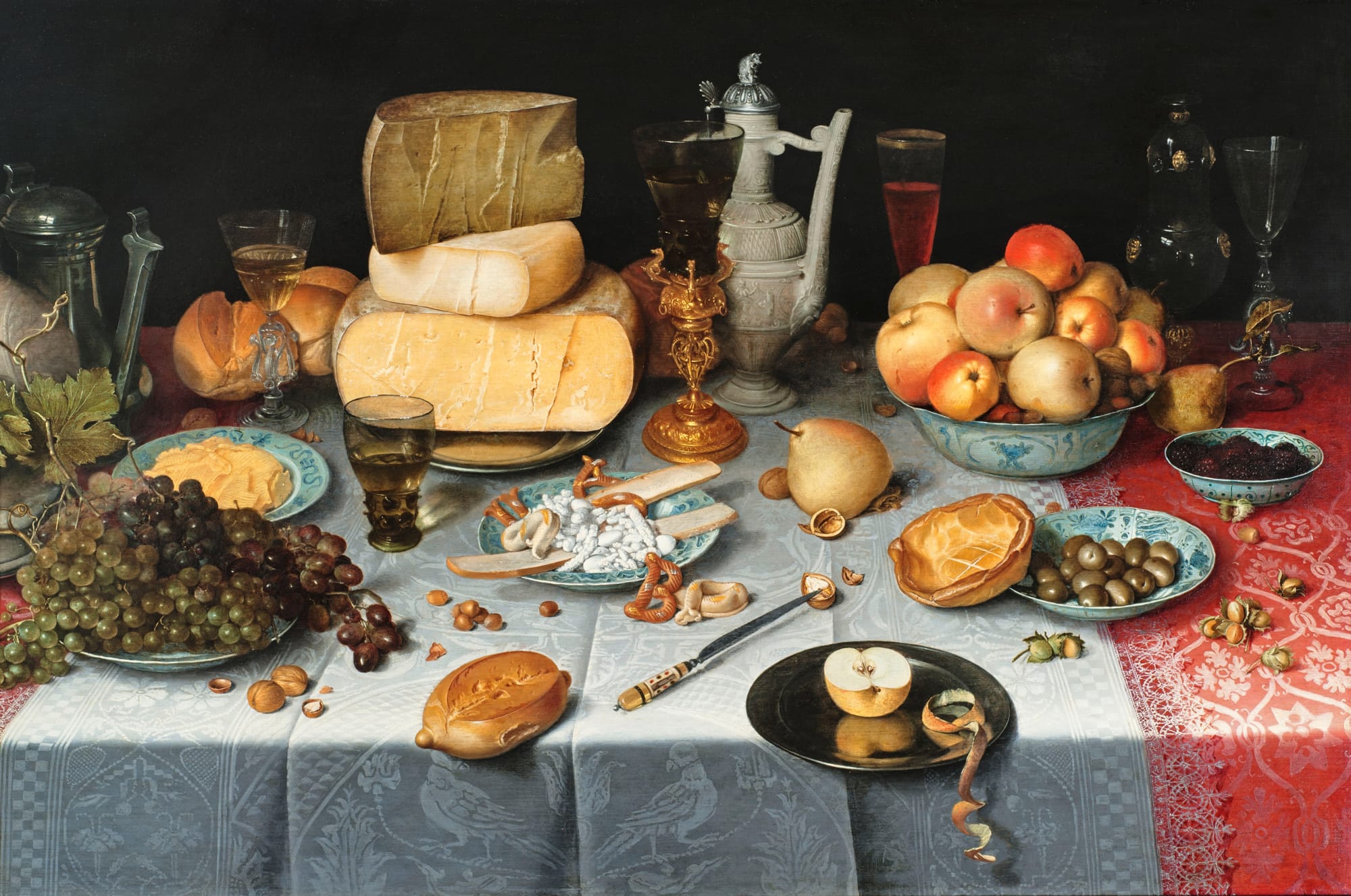
Floris van Dijck (1575-1651), till Life with Cheeses, Apples, Grapes, Olives, Bread, Gold and Silverware and China, 1610
Private collection, Monaco
Contemporary Interpretations
In Tablescapes, Catalan artist Joan Sallas revitalizes these historical techniques. Based on extensive archival research and sources like Giegher’s treatise, Sallas reconstructs the complex folding methods and symbolic meanings of these textile sculptures. His work has been exhibited internationally and featured in presentations for Queen Elizabeth II and Crown Princess Victoria of Sweden.
Complementing these historical reconstructions are the works of Emilie Palle Holm. A graduate of the Swedish School of Textiles, Holm applies contemporary 3D-weaving technologies to the jacquard loom. Her Oriori series explores how flat textiles can transform into dynamic spatial forms, bridging the gap between centuries-old traditions and modern textile design.
Exhibition visitors can imagine themselves at a grand early modern banquet as they observe the play of light and shadow on the woven patterns. Upon closer inspection, intricate details—such as flowers, winding snakes, cannons, or a dove with a branch—emerge from the white-on-white damask surfaces.