
The Art Museum in Cluj-Napoca (MACN), a public cultural institution operating under the authority of the Cluj County Council, is organizing the exhibition The Archaeology of Gaze: visual itineraries between Flanders and Rome (16th-17th centuries), featuring works from the museum’s heritage.
Landscape constitutes one of the major themes of European art, offering both a window into the past and inspiration for the contemporary viewer’s imagination. Vanished places, mysterious groves, and characters from other eras challenge the eye and the spirit to reconstruct lost identities and reflect on the transience of places and people.
The visual adventure begins in the lavish ambiance of certain cities from the sixteenth-century Flemish world, where the artist captures daily life with an almost documentary precision, offering the contemporary viewer the opportunity to let their imagination wander in weaving their own story around the canvas. The exhibition then turns to the groves in the vicinity of Rome in the following century, gradually approaching the Eternal City itself. The Aventine Hill becomes the stage for a folk dance pulsing with the joy and good cheer of ordinary people (bambocciata). The final stop on this visual archaeological journey will be by the Milvio Bridge, a structure that has survived intact from antiquity, a favored motif among artists seeking perfection and fame within the entourage of the pope.
-
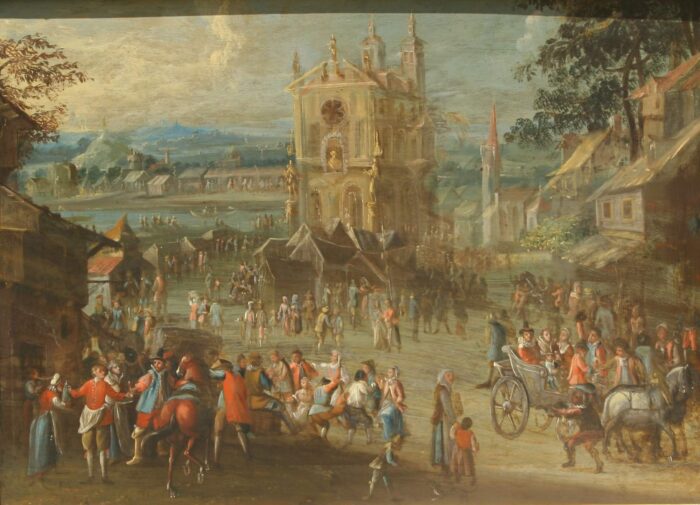
- Anonymous, Celebration in the City, Art Museum in Cluj-Napoca, Romania
-
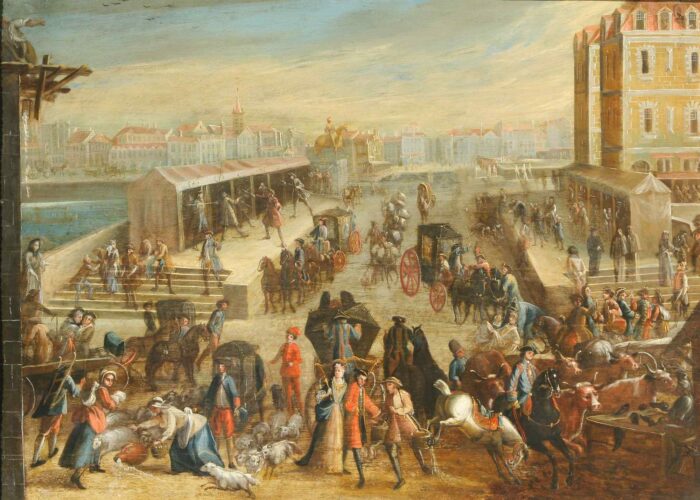
- Anonymous, Life on Pont Neuf (?), Art Museum in Cluj-Napoca, Romania
The theme of the exhibition was chosen to highlight a selection from the the museum’s holdings of European art. The paintings represent an important chapter in the history of the local community and reflect the tastes and practices of collectors from Vienna and Transylvania in the second half of the nineteenth century.
The proposed selection starts with the two sixteenth-century Flemish landscapes, created by an anonymous artist, continues with paintings from the Seicento, namely the forest fragment captured by the French artist Gaspard Dughet in the vicinity of Rome, culminating in two iconic locations for artists of yesterday and today: the Aventine Hill, whose surroundings host a dynamic tavern scene rendered by the Flemish Jan Miel, and the ancient Milvio Bridge reflected in an architectural capriccio in which an anonymous artist recomposes classical visual elements.
Curator: Ioana Filipescu. Ph.D.