
The Golden Age in the Northern Netherlands excelled in numerous areas of painting. Fijnschilders in Leiden, Caravaggists in Utrecht, landscape painters in Haarlem, portrait painters in The Hague, and all these genres, including history painting, in Amsterdam. With other prominent centers like Dordrecht, where, among others, the Cuyp family was active.
When speaking of the Golden Age in the Northern Netherlands—the seventeenth century, that is—Rembrandt naturally comes to mind first. Although he effectively launched his career in Leiden, it was in Amsterdam that his talent ultimately exploded. An Oriental Reading (1632) by Benjamin Cuyp (Dordrecht) strongly recalls Rembrandt’s work of the early 1630s. Cuyp may have been in contact with him at that time, and probably also with the like-minded Jan Lievens. During the first years of their artistic careers, the young Rembrandt and Jan Lievens worked closely together and, in their Leiden years, laid the foundations for careers that would find their culmination in Amsterdam. A panel depicting The Penitent Saint Peter bears Rembrandt’s monogram, originates from his circle, and refers to the famous prototype (1631) now preserved in the Israel Museum in Jerusalem. Two further depictions of Saint Peter exhibited here, respectively by Benjamin Cuyp and Jan Lievens, relate to the same theme. As for the Cuyp family, a Corps de Garde (Benjamin), a Landscape near Dordrecht (Aelbert), and a Caravaggesque Alexander and Diogenes (Jacob) are likewise represented.
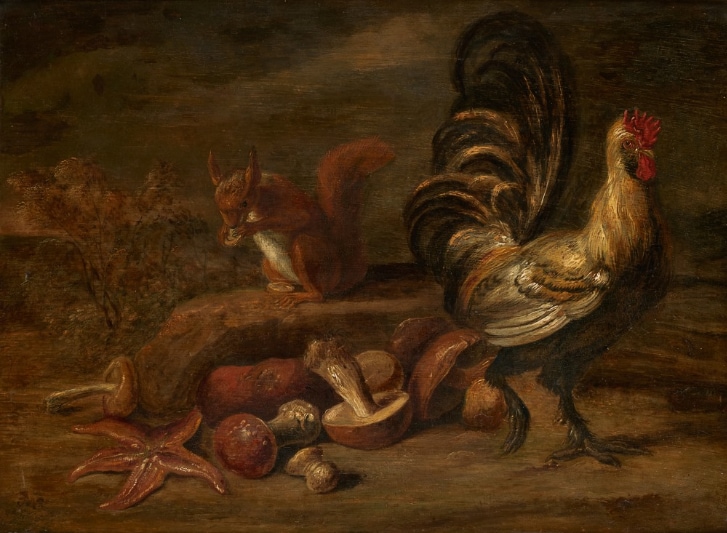
Jan Baptist Weenix (1621-1659), Rooster and Squirrel, oil on panel, 23 x 31 cm
The selection also includes an (imaginary) Church Interior by Anthonie de Lorme and female portraits by Gaspar Netscher and Isaac Luttichuys. Alongside several landscapes by, among others, Jacob van der Croos, Roelof van Vries, Pieter Nolpe, Jan Meerhout (View of Gorinchem), Frans de Momper (an Antwerp painter active in the Northern Netherlands), and Jan Griffier. Works by Jan Baptist Weenix, Quiringh Gerritsz. van Brekelenkam, Jan Miense Molenaer, Jacob de Wet, and Adriaen van der Werff are also included. Finally, the exhibition features Granida and Daifilo by Rembrandt’s pupil Gerbrand van den Eeckhout, a Venus with Cupid by Gerard ter Borch and an Armed Robbery by Highwaymen by Pieter Codde.
The exhibition aims to provide an overview of the Dutch School and its unique themes, iconography, and stylistic characteristics.