
The Royal Museums of Fine Arts of Belgium (KMSKB) is launching a pioneering research project on the world-renowned Errera Sketchbook. This album contains more than 150 exceptional drawings made in Antwerp around 1510–1530 by an unidentified artist. The book was acquired by Paul Errera (1860–1922), a lawyer and professor at the ULB who later became mayor of Uccle, and was bequeathed to the museum after his death. The sketchbook is considered a crown jewel of sixteenth-century drawing in the Low Countries. Alongside numerous drawings of landscapes, rocks, and seascapes on white paper, it contains exceptionally rare drawings on colored grounds, as well as early sketches of Antwerp and the River Scheldt. But the drawings are at risk: they have been kept in a nineteenth-century album with acidic paper mounts. The album will therefore be disbound, and the drawings will be removed from their mounts. The museum is seizing this unique opportunity to examine the loose drawings in as much detail as possible.
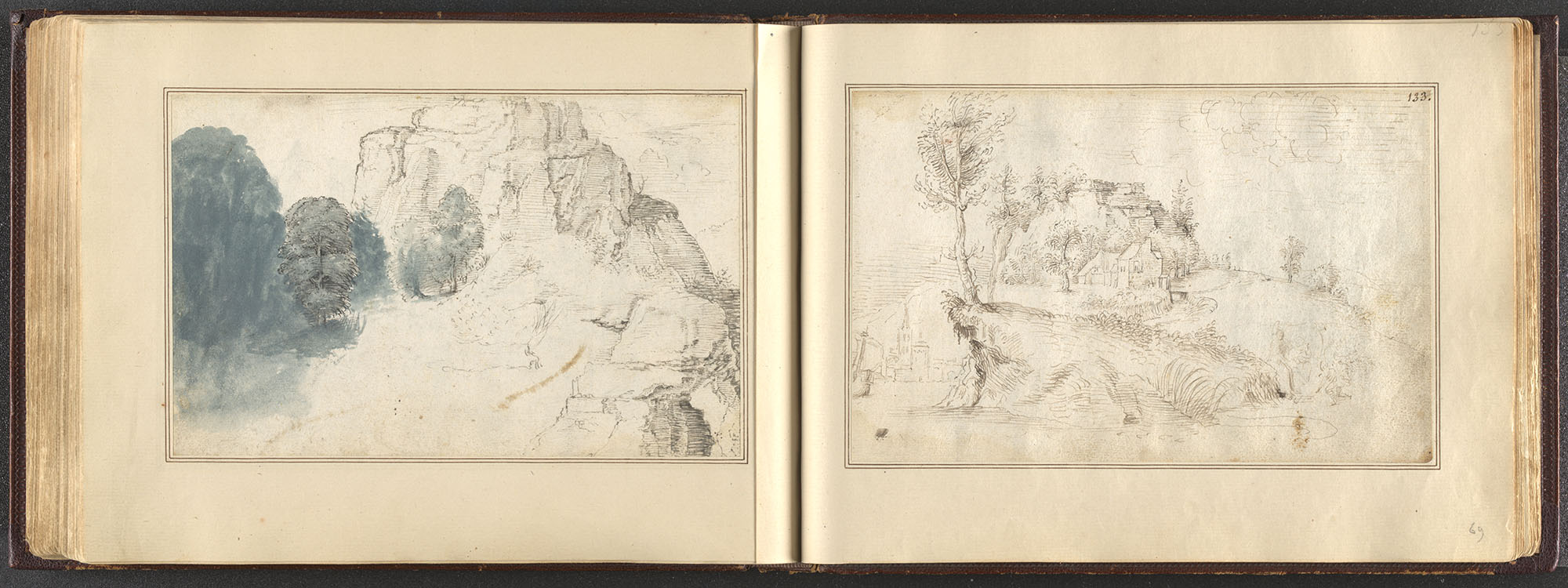
Folios 131v and 133r in their nineteenth-century mounting and binding
Photo: Brussels, Royal Museums of Fine Arts Belgium, Jelle Van Seghbroeck
With financial support from the Professor Jean-Jacques Comhaire Fund of the King Baudouin Foundation and the museum’s Maecenas Circle, an international, interdisciplinary team will dismantle the album and analyze the drawings from the perspectives of technical art history and codicology. The remarkable collection offers a window into drawing practices in Renaissance northern Europe, yet many questions remain unanswered. How was the sketchbook made? By whom? Is the sequence of the pages still original? Why and where were they created, and are they copies or preparatory studies? What kinds of paper and inks were used? And, most importantly, how can these 150 Old Master drawings be preserved for the future?
To answer these questions, the team will compare existing scholarship and literature on the sketchbook with analytical data collected from the drawings themselves. The research will begin with high-resolution photography under raking and transmitted light of each sheet, followed by noninvasive imaging techniques (multispectral imaging, macro X-ray fluorescence, digital microscopy, etc.) applied to a selection of drawings. The collected data is expected to shed light on various aspects of the sketchbook’s history, notably through the study of watermarks, stain and fold patterns, and a more detailed characterization of the drawing materials used. Finally, this “full-body scan” of the sketchbook will provide a comprehensive condition survey to inform future conservation strategies. The Errera Sketchbook will also be investigated in light of its complex relationship with a sketchbook preserved in the Kupferstichkabinett in Berlin, attributed to the Antwerp workshop of Herri met de Bles and dated slightly later (ca. 1535–1543).
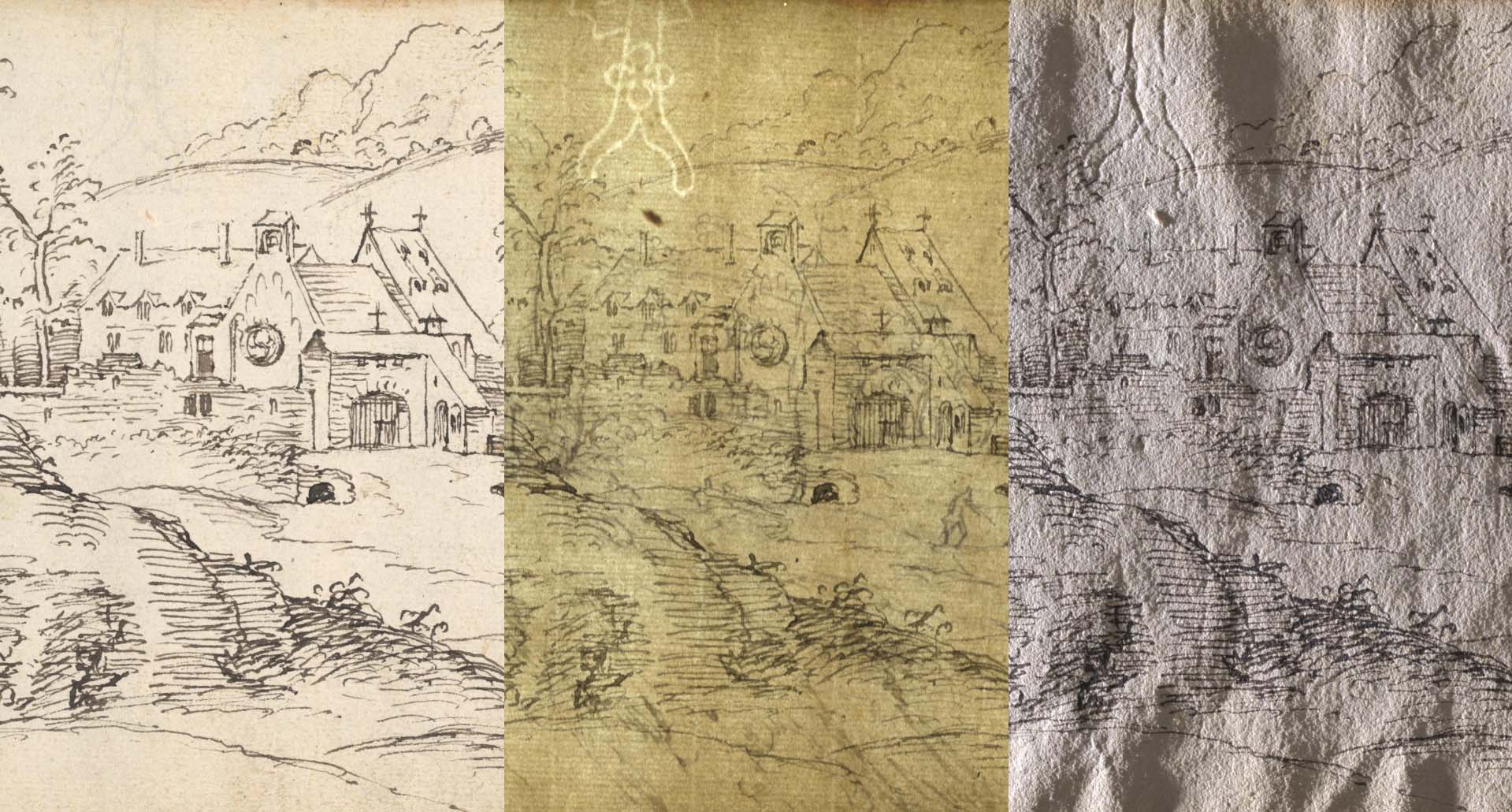
Detail of folio 15r: from left to right: visible light, transmitted light, and raking light photography
Photo: Brussels, Royal Museums of Fine Arts Belgium, Jelle Van Seghbroeck; image processing, registration, and visualization: Pr. dr. Robert G. Erdmann
The project is led by Stefaan Hautekeete, curator of the collection of Old Master Drawings at the KMSKB, together with Dr. Marie-Noëlle Grison, a research fellow specializing in the technical art history of works on paper, and Jelle Van Seghbroeck, photographer. The project brings together the RMFAB, KU Leuven’s Book Heritage Lab and the VIEW Core Facility, an internationally recognized center for heritage science and digitization technologies, led by Professor Lieve Watteeuw and Dr. Hendrik Hameeuw, a cultural heritage imaging specialist, as well as Utrecht University. The university is represented by Dr. Daantje Meuwissen, an expert in sixteenth-century painting and drawing in the Low Countries. Dr. Christien Melzer, curator of Netherlandish and English Art before 1800, and Hanka Gerhold, conservator of printed books and artists’ sketchbooks at the Kupferstichkabinett in Berlin, are also fully involved in the research. The project team further collaborates with Professor Robert G. Erdmann of the University of Amsterdam on image processing, data fusion, and dynamic visualization of the imaging datasets.
The project was launched on 15 September 2026. Its findings will be presented in a major exhibition at the RMFAB in 2030–2031, accompanied by a scholarly catalogue.