
The municipal museum collection managed by M Leuven already holds one of the world’s largest collections of Borman sculptures. With two new acquisitions, M Leuven further strengthens its international reputation as a center of excellence for medieval sculpture and reunites important chapters of Brabant’s artistic heritage in Leuven. These acquisitions enhance the Borman collection not only in quality but also in the diversity of iconographic and compositional types represented.
Seated Virgin and Child on the Crescent Moon (ca. 1490–1510)
This oak sculpture, approximately 40 cm high, can be stylistically attributed to Jan Borman III. It bears the quality mark of the Brussels sculptors’ guild, the so-called “Brussels hammer.” The work also includes an oak pedestal and a halo of later date that was used as a display background.
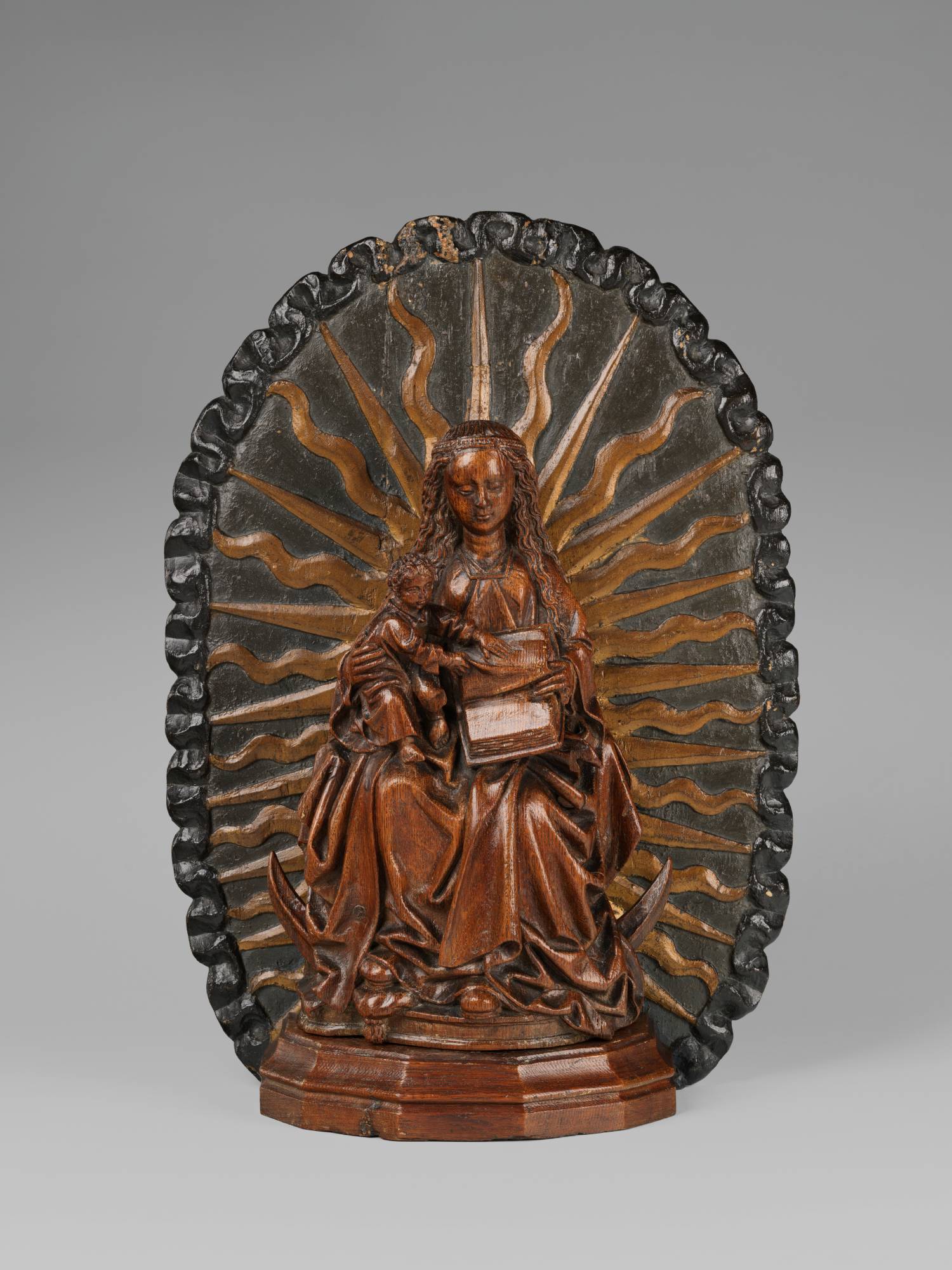
Jan Borman III (the Younger), Seated Virgin and Child on the Crescent Moon, ca. 1490–1510, Collection M Leuven, source: artinflanders.be, photo: Cedric Verhelst
Until recently, the sculpture remained in private ownership and could not be traced. It was known only from old photographs and was exhibited in 1954 in The Madonna in Art exhibition in Antwerp. M Leuven previously lacked a small-scale example of a seated Virgin and Child from the Brabantine tradition.
The sculpture was acquired from the children of Paul Poelmans as part of the estate of Helena Olyslager-Van Herck.
Comparable Madonnas can be found in the collections of the Louvre in Paris, the Bode Museum in Berlin, the Rheinisches Landesmuseum in Bonn, and a collection in Providence, United States. A larger version of this sculptural type survives in the Augustinian convent in Herent and was displayed in the Borman and Sons exhibition in 2019. The Seated Virgin and Child on the Crescent Moon is in excellent condition and demonstrates exceptional sculptural quality.
Kneeling Magus from an Adoration of the Kings (ca. 1500)
In addition to the Seated Virgin, M Leuven has acquired a Kneeling Magus from an Adoration of the Kings, a Late Gothic altarpiece fragment dating from around 1500. The sculpture is attributed to the circle of the Borman workshop and the so-called Master of Piétrebais, a name art historians use for a still-unidentified workshop from Leuven.
This acquisition enriches M’s collection of medieval sculpture with an iconographic theme that was previously almost absent from the museum’s holdings. The Adoration of the Kings was nevertheless a highly popular subject in late medieval Marian altarpieces and scenes from the childhood of Christ.
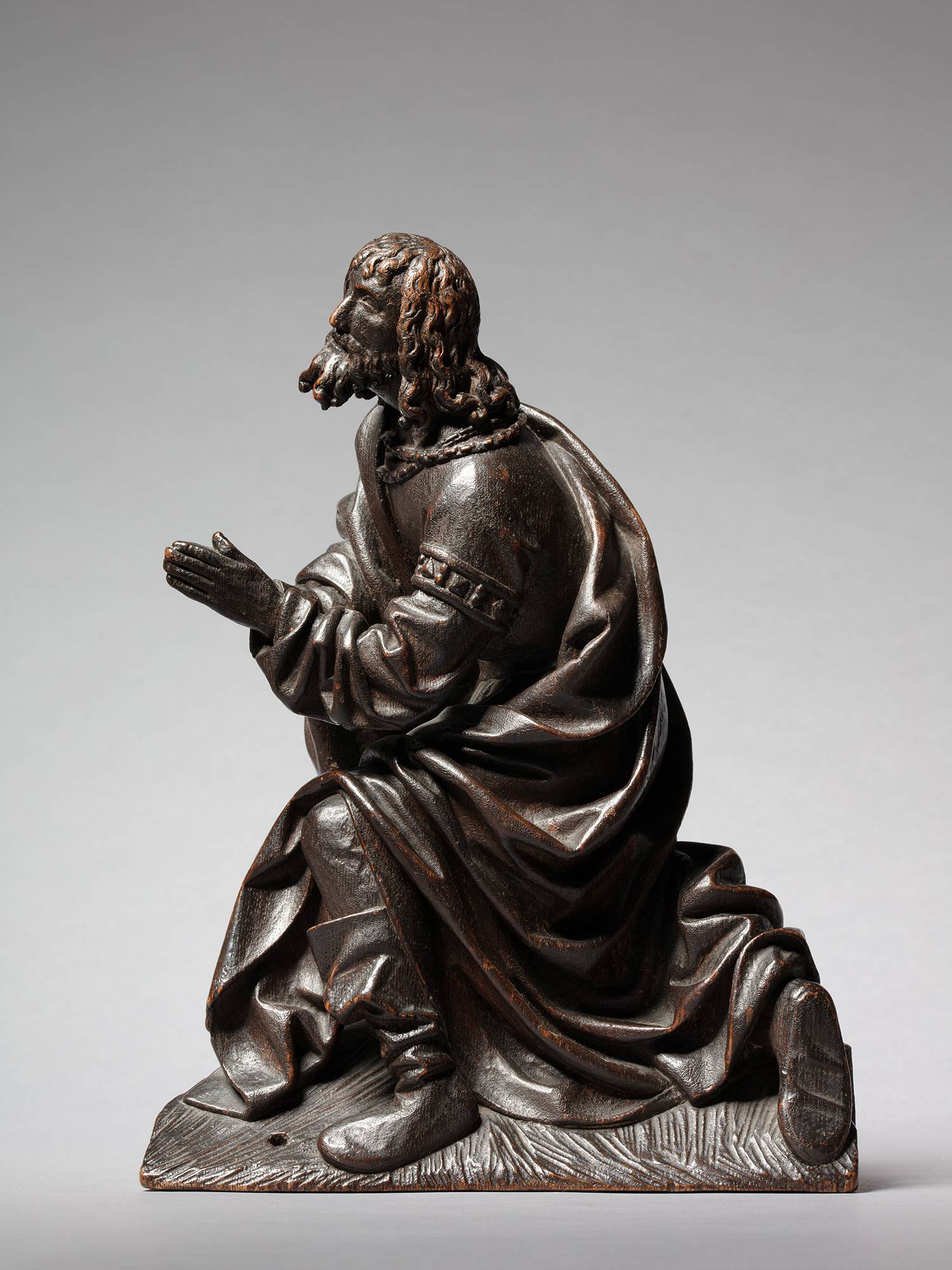
Master of Piétrebais or the Borman Workshop, Kneeling Magus from an Adoration of the Kings, ca. 1500, Collection M Leuven, photo: Courtesy of Sam Fogg, London
About the Borman Family
In the early sixteenth century, Jan Borman II was regarded as the finest woodcarver in Brabant. Indeed, the Borman family dominated sculpture in the Low Countries. The family originated in Leuven, and at least six family members worked as woodcarvers across four generations.
The most renowned was Jan Borman II, who translated the visual language of the Flemish Primitives, such as Rogier van der Weyden, into three-dimensional sculpture. According to some scholars, his work was at least as virtuosic and influential as that of his contemporary, the painter Hieronymus Bosch.
The Bormans supplied Europe’s elite: churches, monasteries, guilds, and even the Habsburg court commissioned their works. Today, their sculptures can be found in leading museums and churches across Europe and the United States. Their most iconic work is the Saint George Altarpiece, created for Leuven but now preserved in Brussels.
Thanks to years of research, M Leuven has become Belgium’s leading center of expertise on the Bormans. Working with national and international partners, the museum has significantly expanded the number of works attributed to the family. Today, more than 350 sculptures are associated with the Bormans.