
Speakers
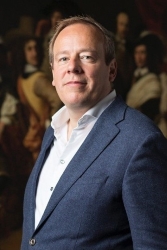 Ingmar Reesing
Curator of the exhibition
Ingmar Reesing graduated cum laude from Utrecht University and has been the curator of Art & History Before 1800 at Museum Gouda since 2018. He previously worked at the Van Gogh Museum and the University of Amsterdam and has been affiliated with institutions including the Rijksmuseum. He has curated diverse exhibitions, including Candlelight (2021), Experience the Wonder of Gouda (2022), Susanna: From the Middle Ages to MeToo (2024), and Wonder Walls (2026). In addition, he has published several articles and exhibition catalogues and is a member of the editorial board of CODARTfeatures.

©Paula Vonhof
Rudy Jos Beerens
Speaker
Rudy Jos Beerens is a Senior Collection Specialist at the RKD – Netherlands Institute for Art History in The Hague. He studied art history at KU Leuven, gaining a PhD with a dissertation on the relationship between social networks and artistic choices among seventeenth-century painters and tapestry designers in Brussels. His fascination with the production and trade of tapestries in the Dutch Republic has remained for over a decade a driving force in his work, in which he focuses especially on the often-overlooked role of women in the industry. In 2023-2024, he studied the history of the tapestry industry in Gouda, with financial support from a Dutch Research Council (NWO) Museum Grant and the RKD. Combining archival research and digital analysis, he explored the ways in which Flemish migrants transformed Gouda into a leading center of tapestry production. His findings became the basis for Wonder Walls, the exhibition on Gouda’s tapestry industry at Museum Gouda, which he co-curated.
Lecture abstract: How Gouda Became a Center of Tapestry Production
Around the year 1600, a remarkable transformation started to take shape in Gouda. Within a few decades, a city with no tradition of tapestry weaving became one of the leading centers of tapestry production in the Dutch Republic – a position it maintained for over a century. How did this happen, and why has this remarkable history been largely overlooked?
This lecture explores Gouda’s tapestry industry through the experiences of the Flemish migrants who settled in the city after fleeing the Southern Netherlands. Bringing technical expertise, commercial networks, and entrepreneurial skills, they established a thriving industry that supplied tapestries to illustrious clients across Europe. Drawing on recent research, the lecture examines the economic, social, and artistic factors underlying Gouda’s success, the strategies that enabled tapestry entrepreneurs to survive and prosper, and the reasons why this important chapter in Dutch art history remained hidden from view for so long.
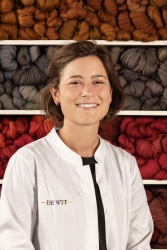
©De Wit Fine Tapestries
Emma Damen
Speaker
Emma Damen gained her master’s degree in conservation and restoration, with a specialism in textiles, at the University of Antwerp in 2015. She acquired work experience at the International Platform for Art Research & Conservation (Iparc), the Antwerp Fashion Museum (MoMu), and the Brussels Fashion & Lace Museum (Mode & Kant) before joining the textile conservation studio at the Royal Institute for Cultural Heritage (KIK-IRPA) in Brussels, where she specialized in the conservation of tapestries. Damen has served as studio manager at De Wit Royal Manufacturers since 2022, leading a team of seven conservators. The team’s recent projects include the conservation of ten sixteenth-century tapestries in the La Vie de Saint-Rémi series from the Musée de Saint-Remi in Reims, four seventeenth-century tapestries from the Les Arts Libéraux series in the Louvre’s collection in Paris, and ten eighteenth-century Tentures des Indes from the Presidential Palace in Malta.
Lecture abstract: The Conservation of Tapestries at the De Wit Royal Manufacturers
In 1889, Theophiel De Wit (1863–1914) founded the De Wit Royal Manufacturers in Mechelen. A century later, in 1980, De Wit started to specialize in the conservation of tapestries. Thanks to its technical expertise, the Manufactory is ideally positioned to shed light on the various facets of tapestries. Although tapestries have been extensively studied within the field of art history, the manufacturing techniques, production processes, and material characteristics of these large-scale textiles are still relatively under-explored. Yet a thorough understanding of these aspects is essential if we are to fully grasp the significance of tapestries in the fifteenth and sixteenth centuries. Furthermore, this technical expertise provides an important basis for the development and application of a sustainable conservation methodology. This lecture will illuminate the production and conservation of tapestries, using examples from various recent projects at the De Wit Royal Manufacturers.