
Museum Boijmans Van Beuningen has added Saint Francis and Brother Leo in Meditation (ca. 1626) by the Antwerp master Adam de Coster to its collection. The painting was rediscovered in 2015 and demonstrates the artist’s innovative approach. Using just a single candle, De Coster creates dramatic lighting effects in a dark interior. The acquisition fills an important gap in the museum’s collection of seventeenth-century Antwerp painting, representing a style of history painting that was previously absent.
The acquisition was made possible with support from the Mondriaan Fund, the Rembrandt Association (including contributions from its Dura Art Fund and Gisbert van Laack Fund), and an anonymous donor.
Light in the Darkness
In the painting, a heavy curtain hangs dangerously close to a burning candle, blocking part of the light in the dark room. On the right, Saint Francis of Assisi sits in prayer, gazing at a crucifix. On the left, Brother Leo reads the Gospel attentively. Books and a skull lie on the table, referring to the transience of earthly life. Francis is preparing for an important event: the moment when, according to Christian tradition, he receives the stigmata—the wounds corresponding to those inflicted on Jesus during the Crucifixion.
In this painting, Adam de Coster takes a remarkable approach to a familiar subject. In the seventeenth century, Saint Francis was often depicted receiving the stigmata or as a penitent saint in a landscape. De Coster, by contrast, portrays a quiet, contemplative moment. The viewer is seemingly invited to witness an intimate scene of prayer and reflection.
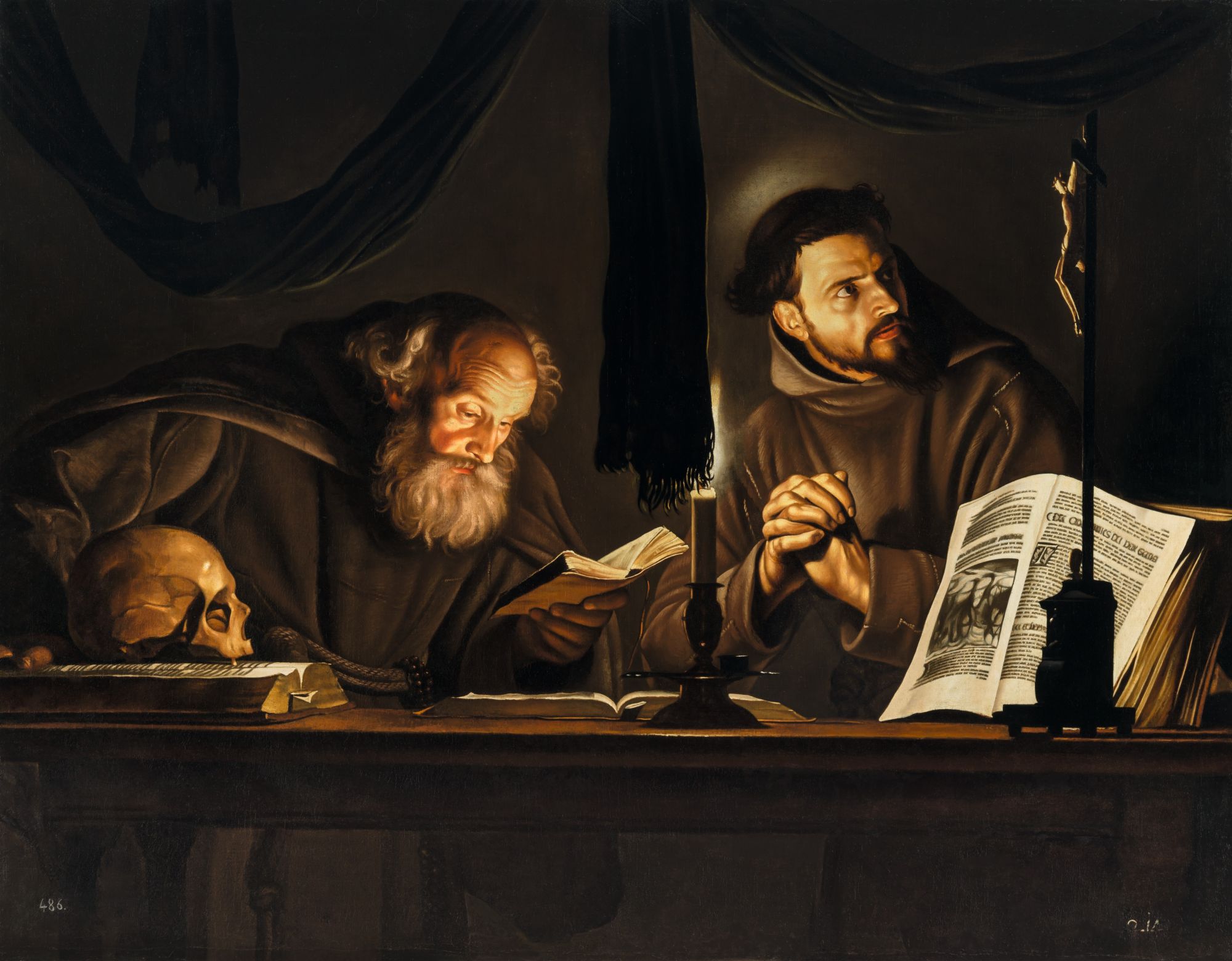
Adam de Coster (1586-1643), Saint Francis and Brother Leo in Meditation, ca. 1626, Museum Boijmans Van Beuningen, Rotterdam
Painter of the Night
Adam de Coster (1586–1643) was born in Mechelen but moved to Antwerp at an early age. After a possible stay in Italy, he returned to the city in 1626, where he became known for his nocturnal scenes and dramatic contrasts of light and darkness. His contemporaries even referred to him as Pictor Noctium (‘Painter of the Night’). Nevertheless, his name gradually faded into obscurity. De Coster did not sign his paintings, and many of his works were consequently attributed to contemporaries such as Gerard van Honthorst (1592–1656) and Gerard Seghers (1591–1651).
Today, Adam de Coster’s work remains rare, with an oeuvre of approximately 40 paintings. For a long time, art historians could reconstruct only part of his oeuvre based on a single print after his now-lost painting Backgammon Players by Candlelight, dating from 1622-1628. The discovery of Saint Francis and Brother Leo in Meditation marked a breakthrough. The painting is the only documented work by De Coster whose attribution is considered certain, making it an important point of reference for future attributions.
The work will be on view from 4 November through 13 December 2026, in the exhibition Sterrennacht (Starry Night), organized in memory of the museum’s recently deceased director, Ina Klaassen.