
A previously unknown portrait by Gerard van Honthorst (1592–1656), depicting Johan Maurits of Nassau-Siegen, has been identified following its acquisition and restoration. The discovery was reported by the Dutch newspaper de Volkskrant on 29 October 2026. Dated 1636, the painting offers new insight into a double portrait in the collection of the Fries Museum in Leeuwarden, which depicts Johan Maurits alongside his younger brother, Johan Ernst.
The painting was acquired in February 2026 by art dealer Jaco Pieper of Argento Gallery at a German auction house. At the time, the heavily soiled and partially overpainted canvas was unidentified, having been cataloged as an anonymous general from the Thirty Years’ War. Although a faint signature of Gerard van Honthorst was visible, the date could not be fully deciphered.
Art historians and CODART Associate Members Rudi Ekkart and Claire van den Donk were subsequently commissioned to investigate the painting. They identified the sitter as Johan Maurits, recognizing his likeness from the double portrait in the Fries Museum. That painting, formerly displayed at the Stadhouderlijk Hof in Leeuwarden, had long been associated with Van Honthorst. Archival research, however, had led to the suggestion that it was a later copy by Pieter Nason, dating from the 1660s.

Gerard van Honthorst (1592–1656), Portrait of Johan Maurits van Nassau-Siegen (1604-1679), 1636
Restoration of the newly discovered painting revealed Van Honthorst’s characteristic fluid brushwork, as well as his original signature and the complete date of 1636. No trace of Johan Ernst was found beneath the overpainted sections, suggesting that the newly identified work represents the original, single-figure composition.
The date is significant in light of Johan Maurits’s subsequent career. In 1636, he departed for Dutch Brazil, where he served as governor until 1644. He also played a role in the expansion of the Dutch slave trade. The portrait may have been commissioned as a family keepsake or intended for his newly built residence in The Hague, now known as the Mauritshuis.
The painting eventually entered the collection of the ducal family of Saxe-Meiningen in Germany, where it remained at Elisabethenburg Palace for centuries. It was partially overpainted, probably during a restoration in the nineteenth or early twentieth century. Confiscated by Soviet forces in 1945, it was subsequently held in a local museum before being returned to the family in 2006. The family consigned it to auction earlier this year.
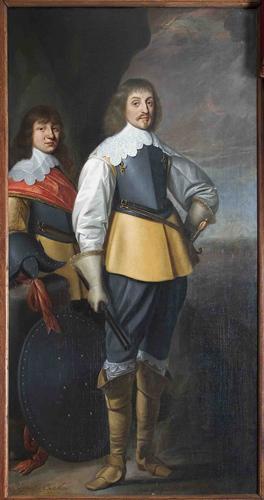
Double Portrait of Johan Maurits of Nassau-Siegen (1604–1679) and Johan Ernst of Nassau-Siegen (1618–1638), Fries Museum, Leeuwarden
The discovery raises new questions about the history of the double portrait in Leeuwarden. Johan Maurits’s brother Johan Ernst accompanied him to Brazil but died of dysentery in 1638, just two years after their arrival. Ekkart suggests that Pieter Nason may have been commissioned to add Johan Ernst to a copy of the original portrait, thereby creating the double portrait that survives in the Fries Museum today.