
Museum De Lakenhal has added Standard-Bearer (ca. 1675), a painting by Bartholomeus Maton, to its collection. The work depicts a Black standard-bearer—an unusual subject at a time when Black people rarely occupied a central role in art. The remarkable acquisition was made by the Friends of Museum De Lakenhal (Vereniging van Belangstellenden in Museum De Lakenhal) thanks to a bequest from Carla van Steijn (1925–2018). The painting will become part of the museum’s permanent display and will go on view from 23 June.
A Tronie of a Standard-Bearer
The painting depicts a man emerging from an oval window. His attire combines both Eastern and Western influences: he wears a red jacket, a turban adorned with pearls and rubies, and carries a green banner. This attribute suggests that he is a standard-bearer. Within the civic guard, the standard-bearer held a prominent position, leading the troops into action. For that reason, the role was traditionally reserved for unmarried young men. The painting is probably not a portrait of an actual standard-bearer, but rather a so-called tronie: an imaginative depiction of a model cast in a particular role.
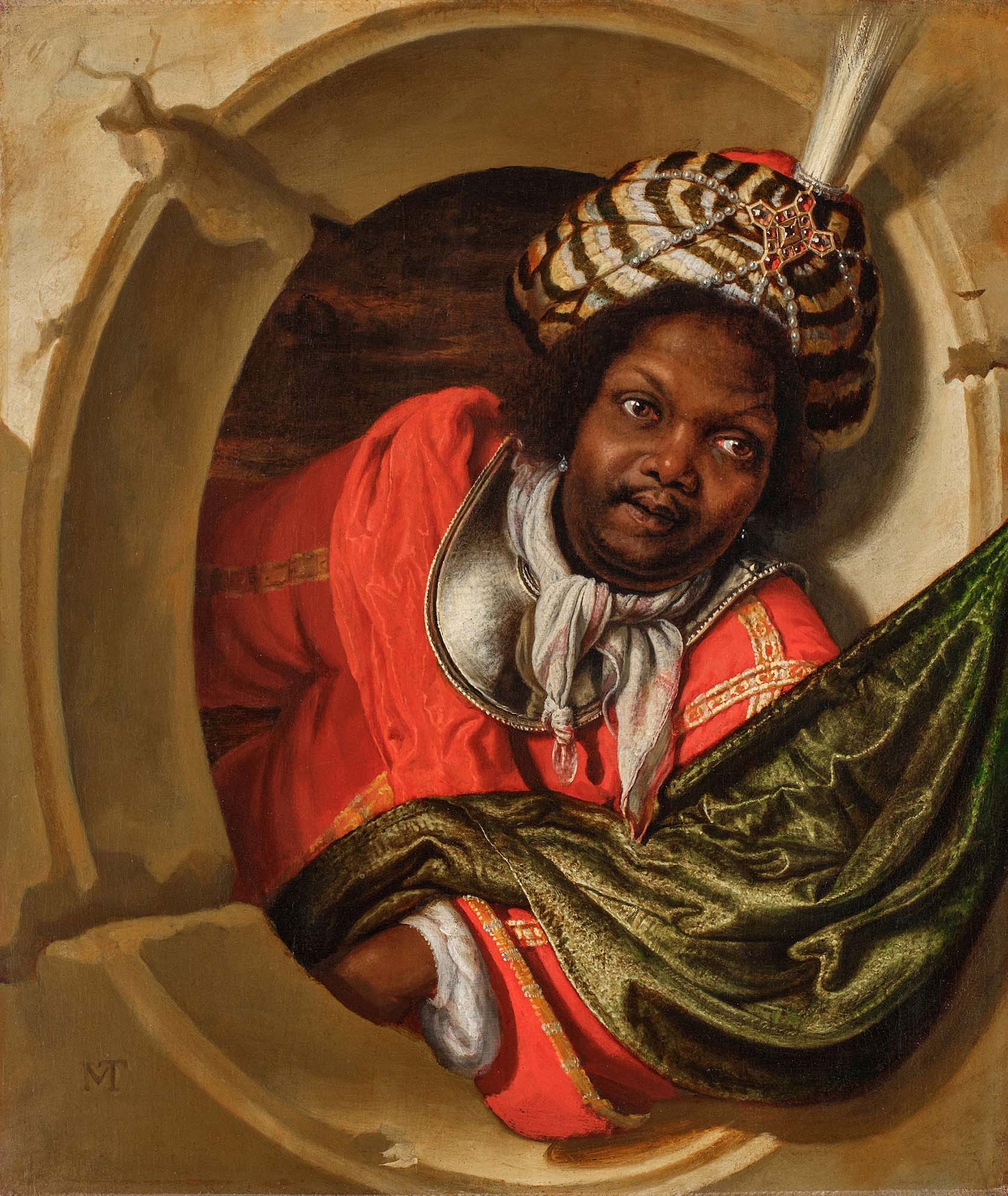
Bartholomeus Maton (1641-1684), Standard-Bearer, ca. 1675, Museum de Lakenhal, Leiden, image courtesy of Sotheby’s
Maton and the Leiden Fine Painters
Bartholomeus Maton was born in Leiden into a family with Southern Netherlandish and German roots. He worked alternately in Leiden and Stockholm, where, alongside his painting practice, he was also active as a wine merchant. Standard-Bearer ranks among the finest works in Maton’s known oeuvre.
Its composition and refined technique reveal the influence of Maton’s teacher Gerrit Dou, Rembrandt’s foremost pupil in Leiden and the founder of the Leiden school of fine painters (Leidse fijnschilders). Dou trained numerous talented artists, including Frans van Mieris and Godfried Schalcken. The small scale of Standard-Bearer is characteristic of the Leiden fine painters, as is the extraordinarily meticulous rendering of fabrics and other materials.
A Black Model
Maton did not portray a stereotype, but an individual. The identity of the model—and whether he was born in Africa, the Americas, or Europe—remains unknown. His face appears again in another painting by Maton, suggesting that he may have been personally acquainted with the artist.
This is particularly noteworthy. Although earlier in the seventeenth century there had been room for full and dignified portrayals of Black neighbors and fellow citizens, this changed around 1660. From that time onwards, Black figures were increasingly relegated to subordinate roles, often placed in the shadows or background. Painted around 1675, Maton’s work follows earlier examples in depicting its subject as a self-assured man dressed in extravagant and luxurious clothing, meeting the viewer’s gaze directly.