
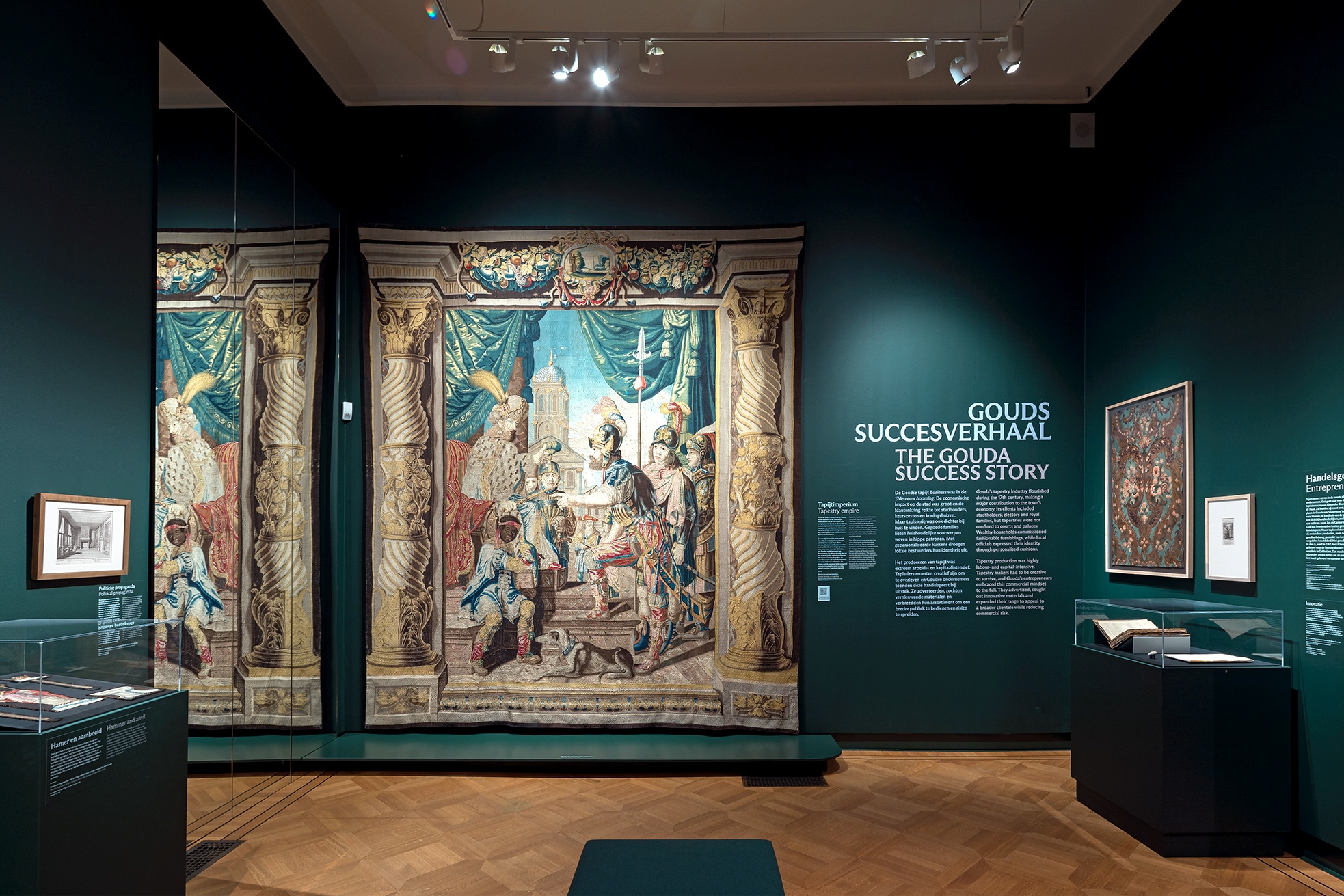
When the city of Gouda started preparing in 1642 to welcome Queen Henrietta Maria of France (1609–1669), queen consort of King Charles I of England, the town hall was exuberantly decorated. According to a contemporary account, it was “hung all around with tapestries.” It has long been assumed that the series of “verdure” (foliage) tapestries that graces the Wedding Hall today was among those once displayed in honor of its royal visitor.
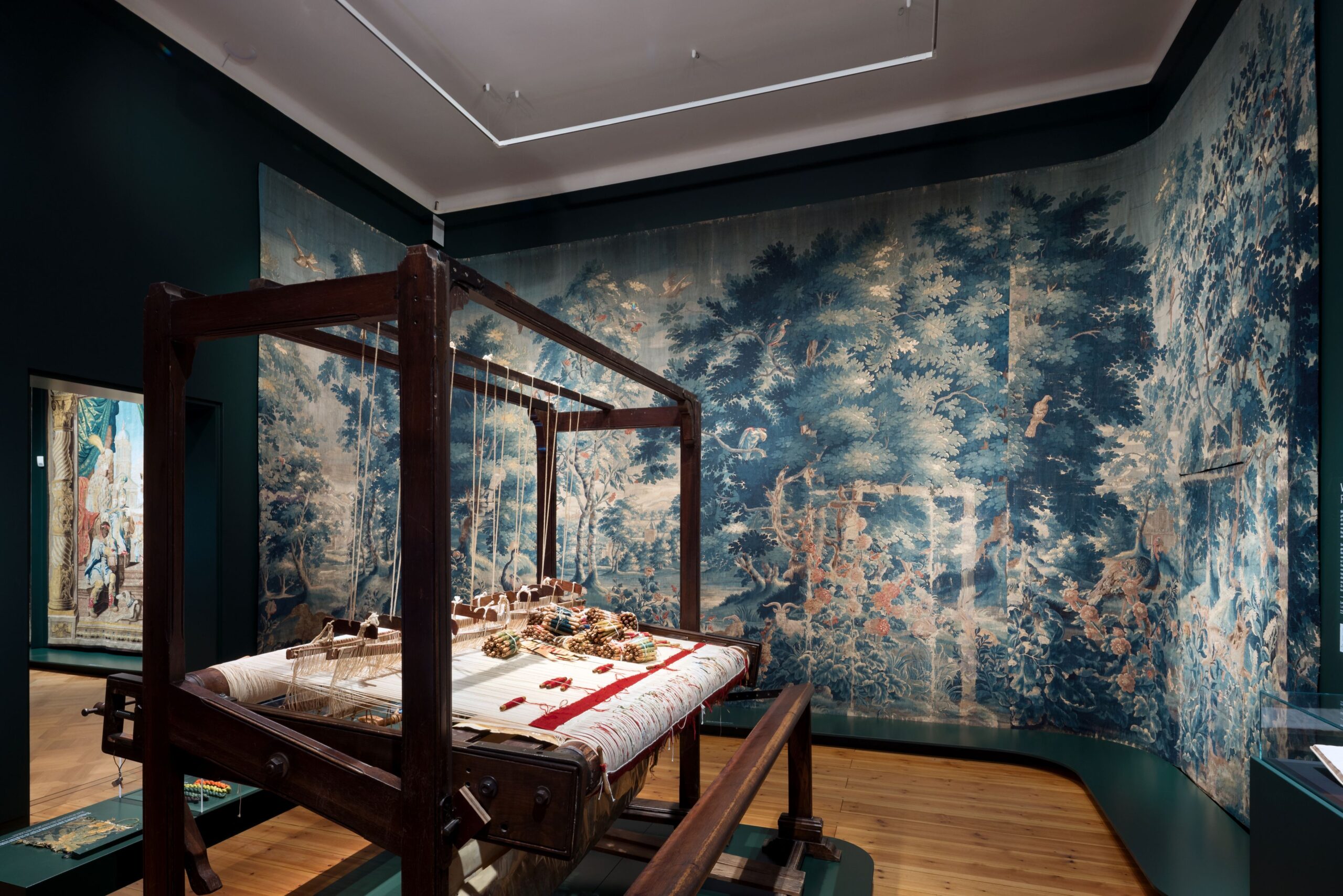
1. Workshop of Jannetje Wouters, Verdure Tapestry, 1692-1694
Town Hall, Gouda
Due to the current renovation of the town hall, the largest tapestry in that series – measuring ten by four meters (w x h) – has been moved temporarily to Museum Gouda. This gave us an ideal opportunity to mount the exhibition Wonder Walls: Woven Masterpieces (26 September 2026 – 28 March 2027). With this exhibition, we aim to bring the regal grandeur of Gouda’s largely forgotten tapestry industry back into the spotlight, showcasing not only the pomp and splendor of this woven art form, but also the collaborative network that underpinned it.
For decades, the story of the Gouda verdures seemed clear: the master tapissier David Rufelaer and his workshop were said to have produced and supplied the tapestries in 1642, after which – half a century later – Jannetje Wouters and her workshop backed them with a supportive lining and modified them with apertures to accommodate doorways. However, when we delved into the archives in preparation for the exhibition, we came across documents that forced us to reassess that familiar story.
Gouda as the Center of Tapestry Production
It was far from coincidental that such a monumental series should have been hung in Gouda’s town hall. In the seventeenth century, Gouda had risen to become one of the main centers of tapestry production in the Northern Netherlands. At the end of the sixteenth century, and especially after the fall of Antwerp in 1585, countless Protestant artisans and entrepreneurs had fled here from the Southern Netherlands. Gouda welcomed these Flemish migrants — many of whom came from Oudenaarde and its surroundings — with open arms. The city council had converted vacant monastic complexes such as the St. Catherine’s and St. Agnes’ convents into living quarters and made them available for use as spacious workshops. Thousands of square meters of precious fabric rolled off the looms there each year, destined for clients ranging from the city of Gouda itself and local guilds to Stadholder Frederik Hendrik and Christina of Sweden.
In spite of this illustrious history, this once flourishing industry fell into near-oblivion in the centuries that followed. Changing tastes and new forms of wall decorations cast the often-expensive tapestries — sometimes quite literally — into the background. At the same time, their appeal was diminished by the effects of light and handling, while impressive series were broken up through auctions, divisions of estates, and bankruptcies, becoming dispersed across different collections. As a result, tapestry as an art form faded from view, and Gouda’s role as a production center vanished almost completely from collective memory.
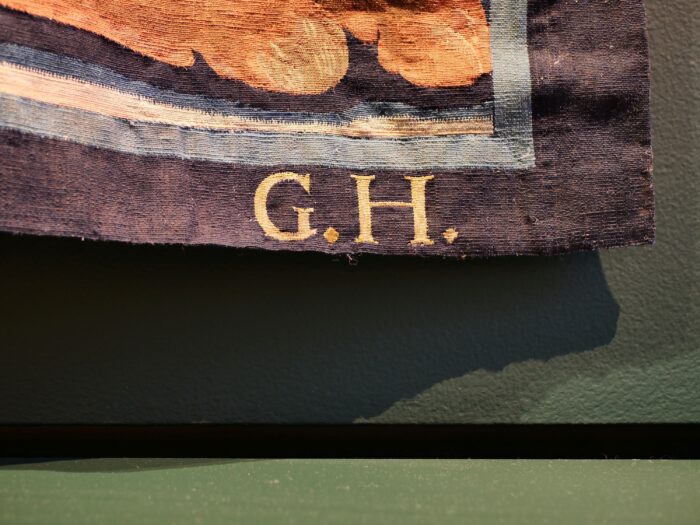
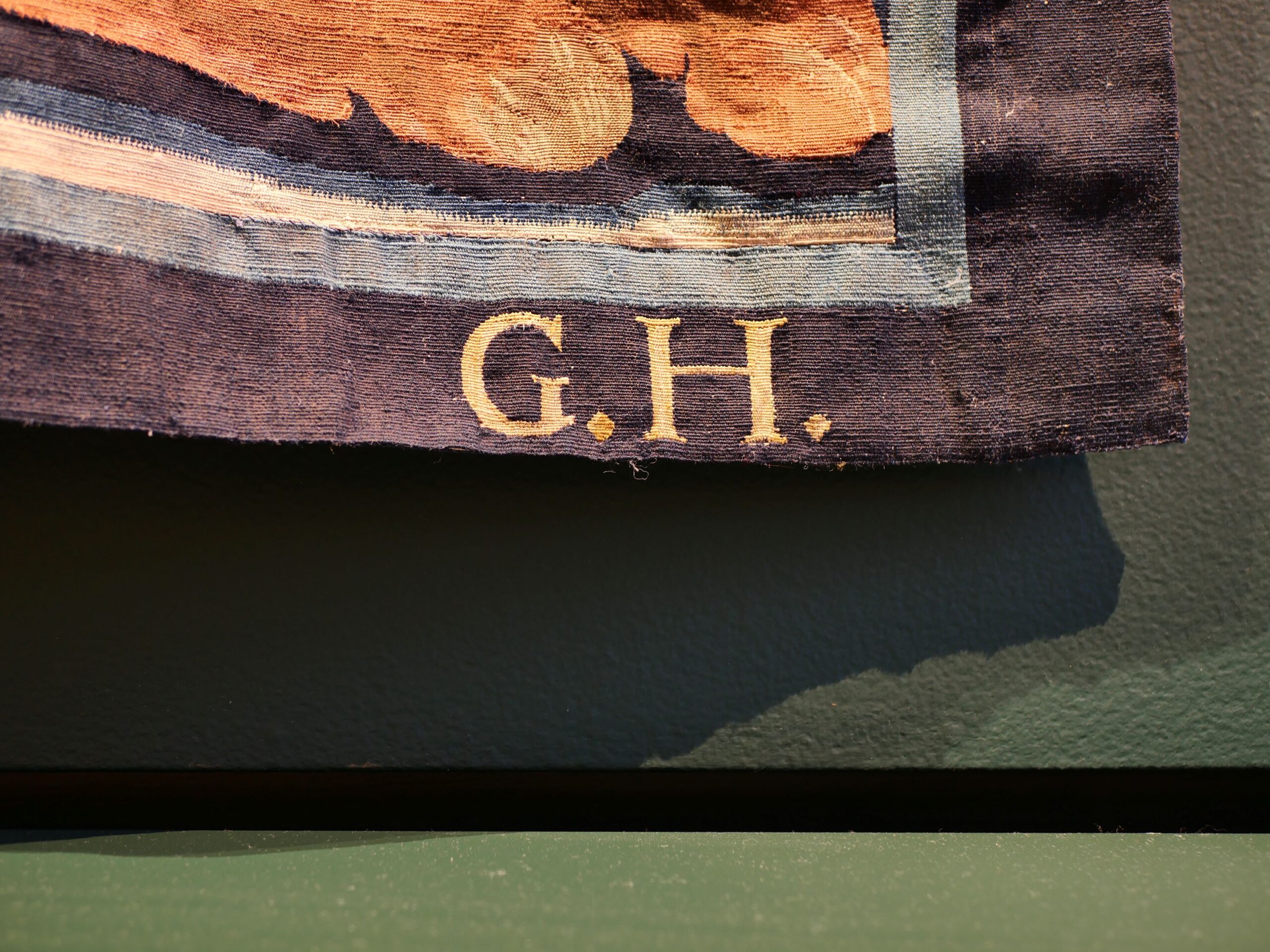
The rediscovery of Gouda’s tapestry history did not begin until 1928, with a chance find in Sweden. The art historian John Böttiger, who was then curator of the Swedish royal collections, found an eight-part series of tapestries depicting The Life of Christ at Skokloster Castle, located between Stockholm and Uppsala. On these tapestries he discovered the name of the tapissier Tobias Schaep and the woven letters “GH.” By analogy with the well-known Brussels example “BB,” standing for “Brussels Brabant,” he interpreted the initials as a city mark for “Gouda Holland.”
-
-
2. Workshop of Tobias Schaep, City mark of Gouda (detail of Crucifixion), ca. 1634-1647
Skokloster Castle, Sweden
-
-
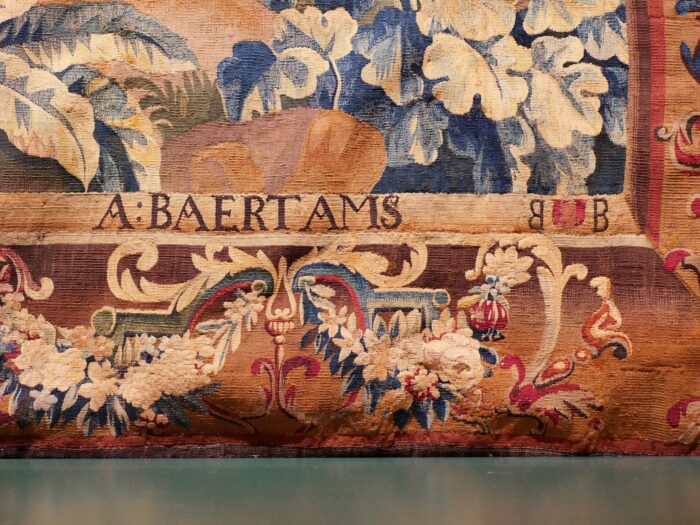
3. Workshop of Alexander Baert and Clara de Hont, Signature Alexander Baert and BB mark (detail of The Continent of America), first half of the eighteenth century
Petit Palais, Paris
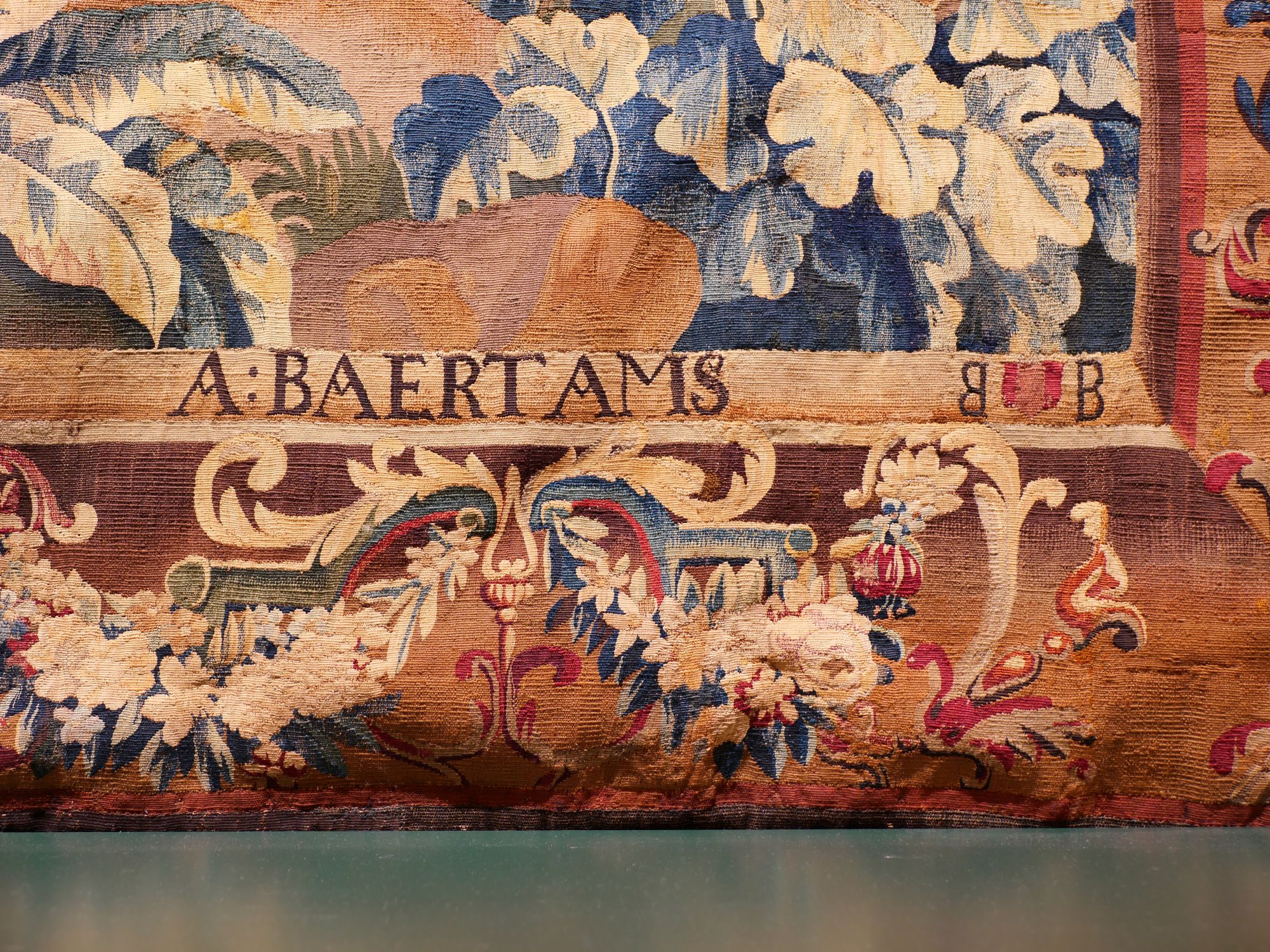
Böttiger’s discovery inspired the Dutch art historian Gerardina Tjaberta van Ysselsteyn to delve into the Gouda archives in the 1930s. There she stumbled upon what she referred to as a “truly overwhelming amount of information” about Gouda as a center of tapestry production. Her pioneering work, however, yielded an intractable paradox: she found the names of hundreds of tapissiers in the archives, yet hardly any surviving tapestries that could be linked to Gouda. The only exceptions were the series at Skokloster and the verdures in the wedding hall of Gouda’s town hall, which she dated to 1642 and attributed to David Rufelaer.
From Names to Tapestries
Over ninety years later, Jos Beerens decided to take that paradox as the point of departure for his research. In 2023, he received an NWO Museum Grant to uncover and map out the largely forgotten history of Gouda’s tapestry industry. He immersed himself in the Streekarchief Midden-Holland in Gouda, studying sources that had previously been overlooked. NWO also encouraged Jos to strike up a partnership with Museum Gouda. The collaboration soon took shape, starting with a meeting between Sabine Craft-Giepmans – who was then Jos’s line manager at the RKD – Netherlands Institute for Art History in The Hague – and Ingmar Reesing at a CODART event.
The research brought to light a richer and more complex history than had previously been known. The sources reveal the ingenuity of Gouda’s tapissiers, the diverse roles that women played in the industry, and the appeal that Gouda held for entrepreneurs from elsewhere.
For this exhibition, we sought to evoke that richness rather than merely rely explanatory texts. We wanted to allow the key figures of this industry to speak directly to visitors through the documents they wrote, drafted, or signed. To achieve this, we had large-format quotations from historical sources applied to the walls of each gallery and selected relevant documents to accompany the tapestries. In this way, visitors experience how archival sources reshape the way we look at the artworks. From behind the monumental tapestries, the people, experiments, and business decisions that made their production possible come into view.
A patent application submitted in 1649 by the Gouda tapissier David Schaep (son of Tobias) offers a striking illustration of ingenuity with materials. Silk was so expensive that Schaep went in search of a viable alternative and hit upon camel hair. To protect his discovery, he applied for a patent directly with the States General, arguing that this cheaper material could be just as beautiful, smooth, and lustrous as silk, giving the fabric the same sheen.
4. Workshop of Pieter de Cracht, Orestes’ Revenge on Aegisthus, ca. 1648-1662
Rijksmuseum, Amsterdam
The sources also show that production was not confined to Gouda alone. Pieter de Cracht lived in Amsterdam and his brother-in-law Joris Nauwincx in Schoonhoven, yet both also had tapestries woven in Gouda. This was already known from Van Ysselsteyn’s research, but a recent archival find has yielded further details. In a contract granting De Cracht a quarter share in the Nauwincx tapestry workshop, the men described their collaboration as a “Company dealing in Tapestries, which may be made and/or purchased in Schoonhoven, Gouda, or elsewhere, at their respective workshops.”
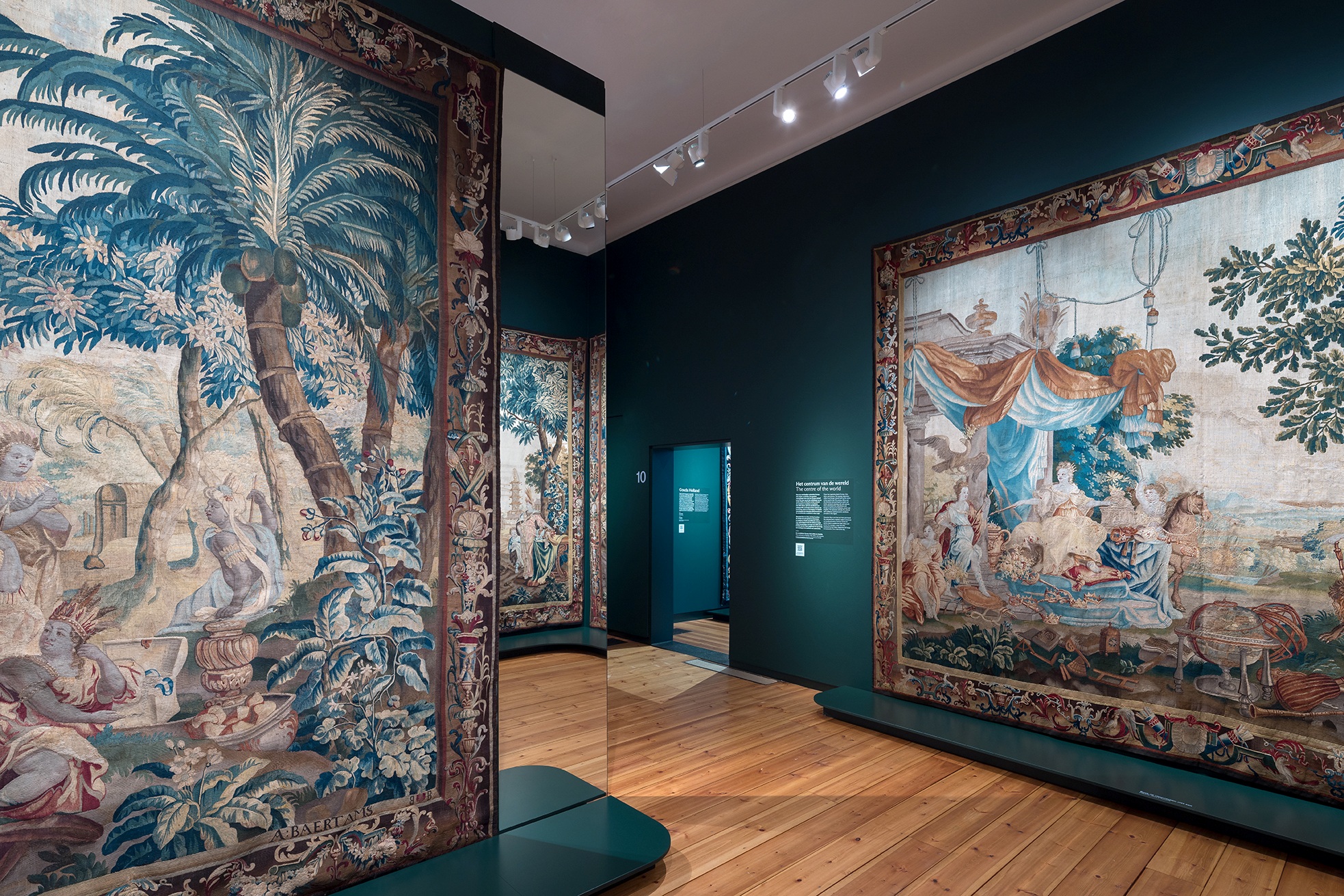
5. Workshop of Alexander Baert and Clara de Hont, The Continents of Europe and America, first half of the eighteenth century
Petit Palais, Paris
Four monumental tapestries from the Petit Palais in Paris, depicting The Four Continents and on view in Wonder Walls, illustrate how a tapestry may have been woven in a very different place from the city to which it appears linked at first sight. They bear the signature A. BAERT, the Amsterdam mark AMS, and the Brussels city mark BB. These marks refer to Amsterdam, where Baert and his wife Clara De Hont lived from 1699 onwards and ran their main workshop, and to Brussels, where the couple had previously resided for a short time. However, the archives show that Baert and De Hont did not acquire the cartoons for this popular series until 1714. At that time, their tapestries were primarily being produced at their second workshop in Gouda, which employed as many as 25 weavers at its peak.
Jannetje Wouters and the Reattribution of the Town Hall Series
While the research provided an increasingly clear picture of the external networks that sustained Gouda’s tapestry production, the most spectacular revelation to emerge from the archives conserned the very object with which this article began: the monumental tapestry series from the wedding hall in Gouda’s town hall.
While we were searching the Streekarchief Midden-Holland in preparation for Wonder Walls, looking for evidence of the later work that Jannetje Wouters was thought to have carried out on the verdures attributed to David Rufelaer, the research took an unexpected turn. Coretta Bakker-Wijbrans from the Regional Archives delved into stacks of town accounts and sent us a photograph with the surprising but crucial question: “Which of the two is it?”
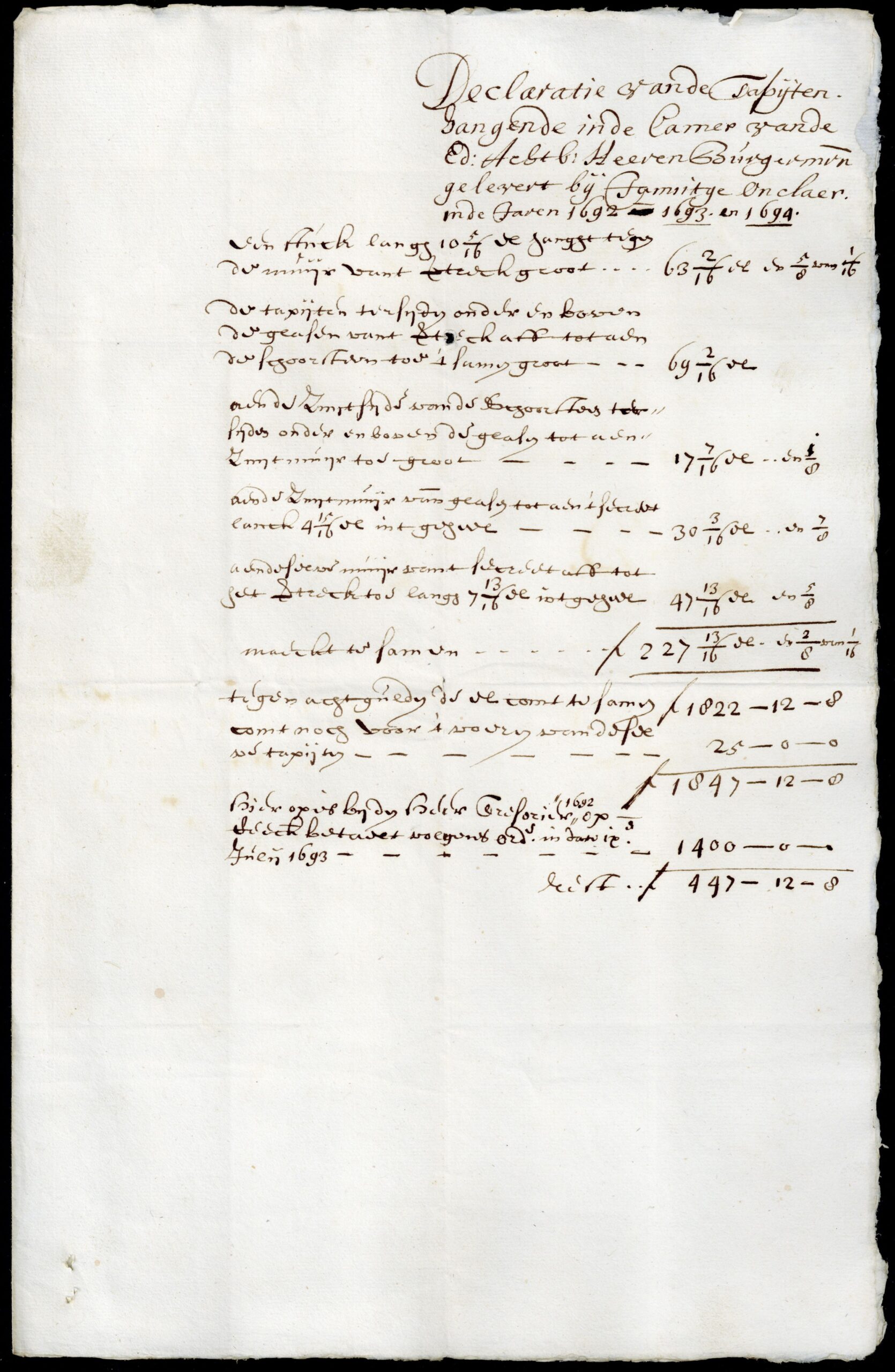
6. Invoice for the verdure tapestry by Jannetje Wouters, 1694
Streekarchief Midden Holland, Gouda
Further study of the archives revealed that Wouters appeared not once, not twice, but numerous times in the town records relating to the tapestries. Most notably, we discovered a detailed invoice showing that Wouters had not cut doorways into existing tapestries, but out of a series of new tapestries that she herself had supplied to the city between 1692 and 1694. The dimensions listed in the document correspond almost exactly to those of the tapestries that had adorned the town hall for centuries.
In the verdures themselves, Wouters demonstrated the same ingenuity that we have noted in her colleagues from Gouda. She incorporated the motif of a running wolf or fox into the landscape. For this figure, she used a cartoon that the Delft tapissier Maximiliaen van der Gucht had employed over a quarter of a century earlier — around 1665-1666 — for Nijmegen’s town hall: a cartoon that Wouters had presumably acquired when Van der Gucht sold his second Gouda workshop in 1681. In Wonder Walls, Van der Gucht’s Nijmegen tapestry hangs shoulder to shoulder with Wouters’s, while the invoice documenting her delivery of the series completes the story.
A Present-Day Perspective
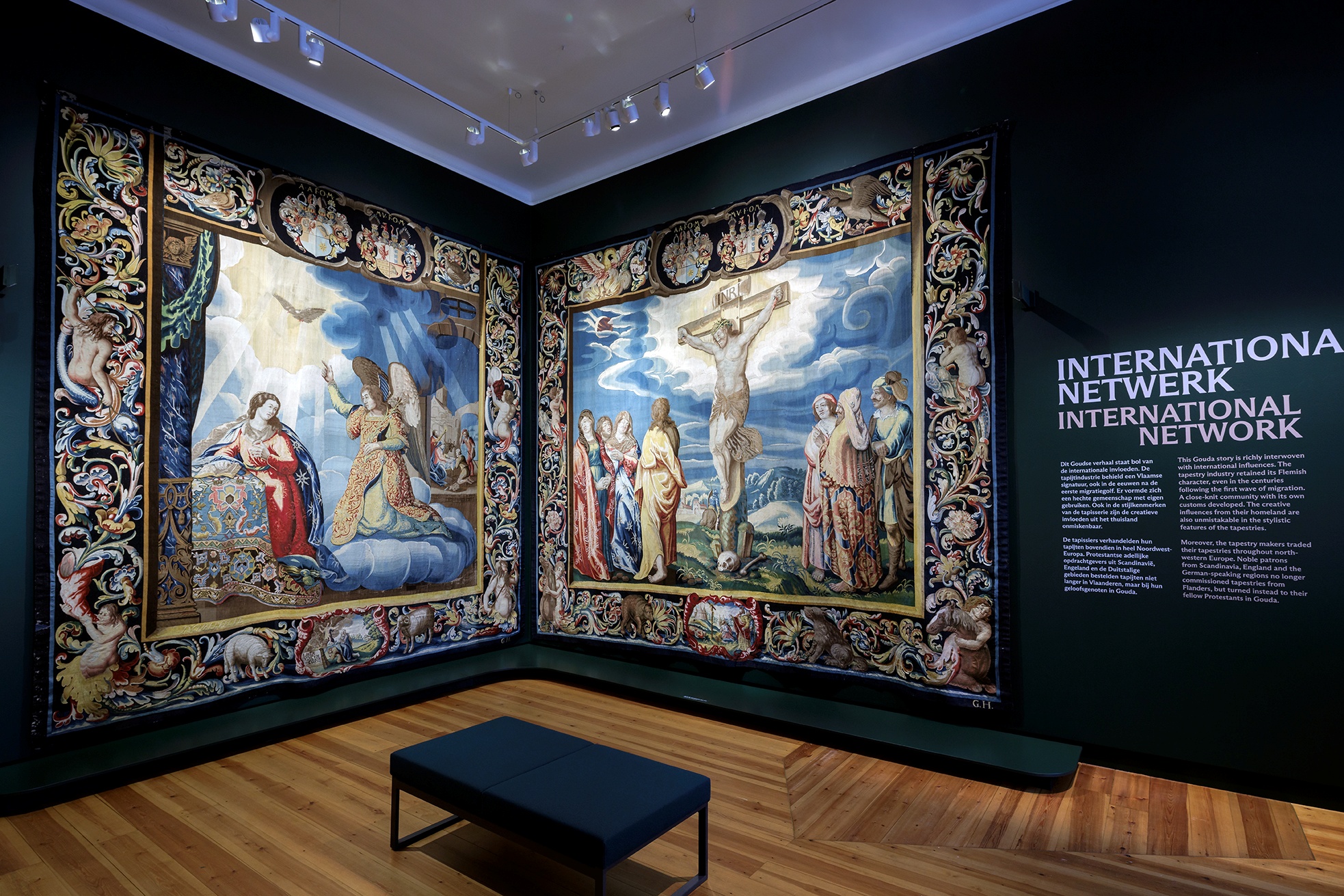
7. Workshop of Tobias Schaep, Annunciation and Crucifixion, ca. 1634-1647
Skokloster Castle, Sweden
Tapestries produced in the seventeenth century are among the largest, most valuable, and most prestigious artworks from the Northern Netherlands. Yet until now, these monumental textiles and their creators have received little attention. Wonder Walls is the first major exhibition in the Netherlands devoted to this art form. Several masterpieces from countries including Sweden and France have never before been displayed here and are returning – for the first time in centuries – to the city of Gouda, where they were once woven. New knowledge and insights return the spotlight to forgotten tapissiers – both women and men – and reveal how their workshops and networks shaped tapestry production throughout the Northern Netherlands.
At the same time, Wonder Walls tells a story of migration and integration. Flemish tapissiers who had fled war and religious persecution found the opportunity to continue practicing their art in Gouda, where their knowledge and skill contributed to a thriving industry. Their stories show how migration has helped shape our cities, economy, and culture for centuries.
Much research on Gouda remains to be done. Tapestries, cushions, and tablecloths that are currently attributed to Delft, Amsterdam, or “the Northern Netherlands” merit renewed attention: they may in fact have been produced in Gouda. The exhibition is therefore not only a re-evaluation of a forgotten chapter in art history, but also an invitation to re-examine existing attributions.
Dr. Rudy Jos Beerens is Senior Collection Specialist at the RKD – Netherlands Institute for Art History in The Hague. He was a member of CODART from 2023 to 2025. Ingmar Reesing is Curator at Museum Gouda. He has been a member of CODART since 2018 and a member of the editorial board of CODARTfeatures since 2021.