
The Leiden Collection has announced the acquisition of Rembrandt van Rijn’s Saint John on Patmos (ca. 1661), bringing the total number of works by the artist in the collection to eighteen. The painting was acquired at Sotheby’s London last December for $9 million, according to The Art Newspaper. The announcement is accompanied by the publication of a scholarly essay about the work and its significance — authored by Dr. Arthur K. Wheelock Jr., Senior Advisor to The Leiden Collection.
According to Kaplan the new addition “significantly strengthens the overarching narrative that The Leiden Collection traces, from the artist’s earliest signed works inLeiden to his final years in Amsterdam. We look forward to having this most serenely movingmasterpiece travel as part of our continuing world tour, bringing ‘the Universal Artist’,Rembrandt, and his school to broad and diverse audiences.”
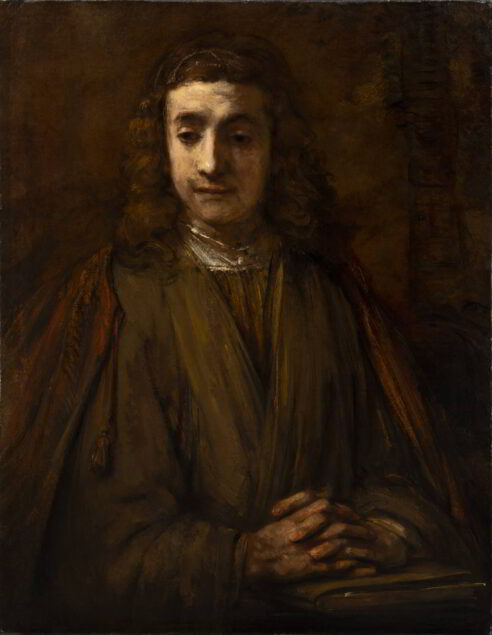
Rembrandt (1606-1669), Saint John on Patmos, ca. 1661
The Leiden Collection, New York
Executed late in Rembrandt’s career, the meditative painting depicts the evangelist John during his exile on the island of Patmos reflecting after receiving his revelation. Long out of public view, the canvas was previously known to scholars primarily through a 1920s photograph that misidentified the sitter as Rembrandt’s son, Titus. Technical examination and conservation treatment prior to the 2025 auction revealed background details—including a palm tree denoting Patmos and the eagle associated with Saint John—confirming the religious subject.
Rembrandt likely selected his son Titus as the model for Saint John to convey the spiritual weight of the moment, utilizing the young man’s physical features and long curly hair to match the traditional iconography of the evangelist. By portraying Titus in the guise of Saint John, Rembrandt created a work that serves both as a religious depiction and a personal expression of his bond with his son.
Provenance
The provenance of Saint John on Patmos can be traced to 1760, when it appeared in the sale of the collection of Gerard Hoet II in The Hague. By 1768, it entered the collection of Gottfried Winckler in Leipzig as one of ten Rembrandt paintings in his holdings. An early nineteenth-century watercolor depicts the artwork—then in an arched format—installed in Winckler’s gallery.
Following its dispersal, the painting moved through private hands in London and New York. Misattributed in the early twentieth century to Rembrandt’s pupil Carel Fabritius, it was recognized as an authentic Rembrandt depicting the artist’s son Titus by Wilhelm Valentiner, who acquired the canvas in 1913 while serving as a curator at the Metropolitan Museum of Art. Valentiner subsequently sold the work to the collector Dr. Karl Lanz in Mannheim.
In 1926, the painting was acquired by the industrialist and art collector Friedrich Thyssen. Although Thyssen actively supported the Nazi regime initially, he broke with the party in 1939 and was subsequently imprisoned in concentration camps for the remainder of the Second World War. The canvas remained in the Thyssen family until the 2025 sale in London, when it entered The Leiden Collection.