
When I first started working for the Serlachius Museums, I had very little knowledge of Dutch and Flemish art. I had written my doctoral thesis on a Finnish modernist painter and had mainly worked with modern and contemporary art — at Sara Hildén Art Museum and a commercial art gallery in Tampere, Finland.
My first job at Serlachius was in 2017, when I substituted for the registrar. The industrialist Gösta Serlachius (1876–1942) established the Fine Arts Foundation that bears his name in 1933. The Foundation manages a museum and preserves an art collection in the small municipality of Mänttä-Vilppula in central Finland. The collection currently consists of about 10,000 artworks, about 100 of which are Old Masters, including Dutch and Flemish paintings.
In my first year, I assisted in a research project focusing on the provenance of some of the works from the museum’s Old Masters collection – my first professional involvement with European Old Masters. This project included works from the Spanish Baroque and a number of Italian paintings as well as Dutch and Flemish art.
I came across many names that were unfamiliar to me, such as Blas de Ledesma and Jan Wellens de Cock. It proved extremely difficult – in some cases impossible – to find out anything about these elusive artists and I started to question some of the attributions. If there are hardly any references to them in books or archives or online, how were these attributions made? Furthermore, the few images I was able to find on museum websites and online auction catalogues did not appear to be by the same hand as the paintings in our collection.
One painting in particular caught my eye. It bore the rather baffling title of The Temptation of St. Anthony and St. Paul and was attributed to the Flemish painter Jan Wellens de Cock (fig. 1). It was dated to the early sixteenth century – I assumed mainly because of the attribution.
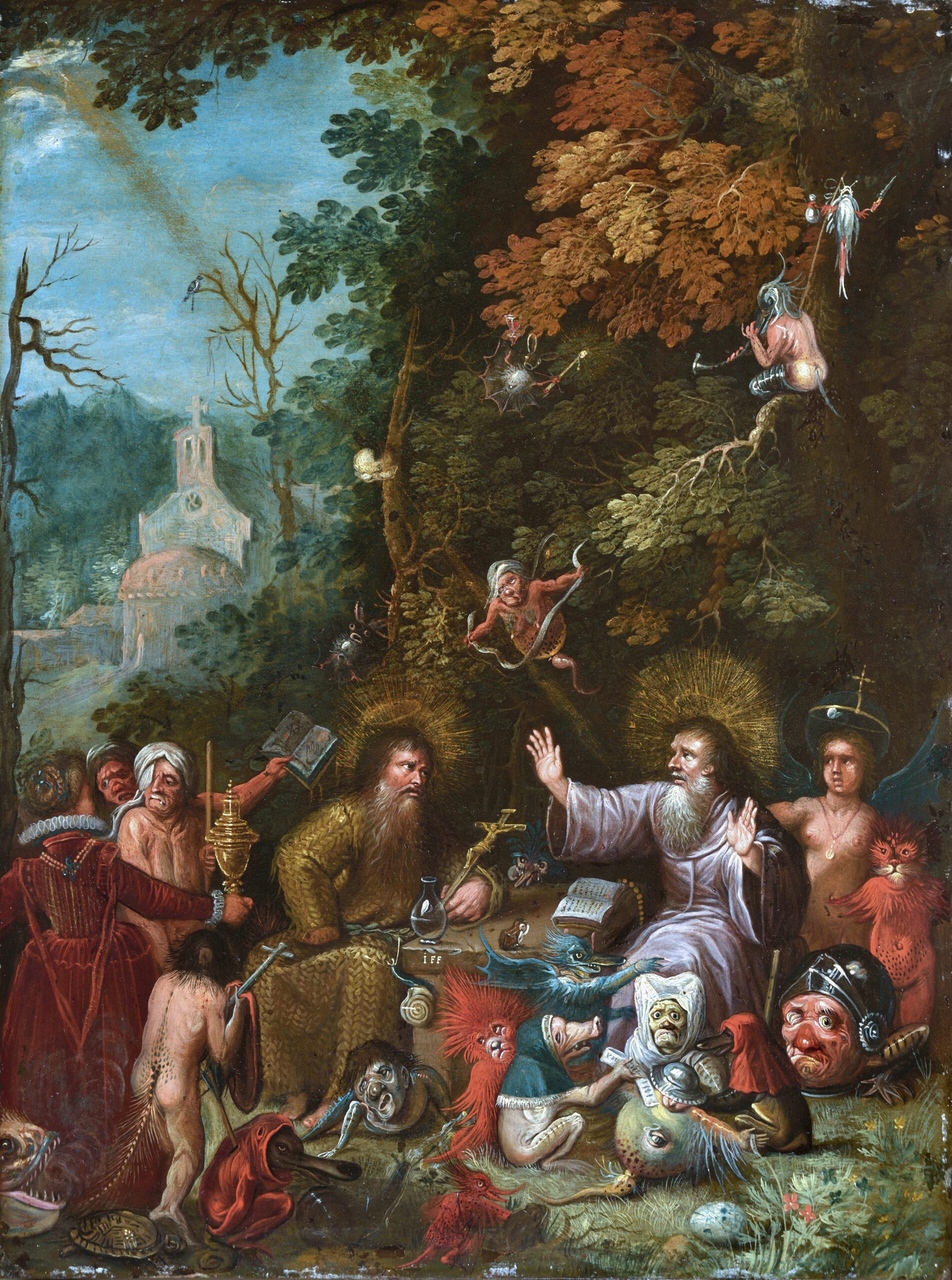
Unknown artist (possibly Hieronymus Francken the Younger), The Meeting of St. Anthony and St. Paul, early seventeenth century, oil on copper, 29 x 22.5 cm
The Gösta Serlachius Fine Arts Foundation, Mänttä. Photo: Hannu Miettinen.
The Temptation of St. Anthony is of course a common subject in art history. We also quite frequently encounter paintings depicting the meeting of the hermits St. Anthony and St. Paul in the desert. However, this was the first time I had seen these two motifs combined. (My Estonian colleague Greta Koppel recently sent me an image of another painting combining these two subjects, by Maerten de Vos from St. James Church in Antwerp.) Although Jan Wellens de Cock had depicted the Temptation of St. Anthony, the painting in our collection seemed stylistically to belong to the early seventeenth century.
In my quest for research on the painting, I discovered that the German art historian Ursula Härting had suggested some decades ago that the letters visible on the edge of the table in the painting, “IFF,” could be interpreted as “I-eronymus F-rancken F-ecit”, suggesting an attribution to Hieronymus Francken the Younger. Indeed, some of the tormenting demons are stylistically reminiscent of similar figures in other works by the Francken family, such as the Witches’ Kitchens by Hieronymus’s brother, Frans Francken the Younger. In addition, the work is painted on copper, which means that it must date from the early seventeenth rather than the early sixteenth century.
In December 2025, I passed on my information about the painting to Natasja Peeters, who wrote her doctoral dissertation on the Francken family. After studying this information and key images, Peeters also concluded that the work was most probably by Hieronymus Francken the Younger. However, since neither Härting nor Peeters has seen the painting first-hand and the research is at an early stage, we are attributing it in our collection (for the time being) to an unknown painter, although we have changed its dating and title.
This example illustrates how much work remains to be done with our Old Masters collection. It also served as my introduction to the fascinating world of European Old Masters. In 2019, I started working full-time as a curator for Serlachius and gradually assumed responsibility for the museum’s Old Masters collection. I studied ways of conducting more research on the collection and of communicating to scholars that we have a small but interesting collection of European Old Masters in a region that is off the beaten track.
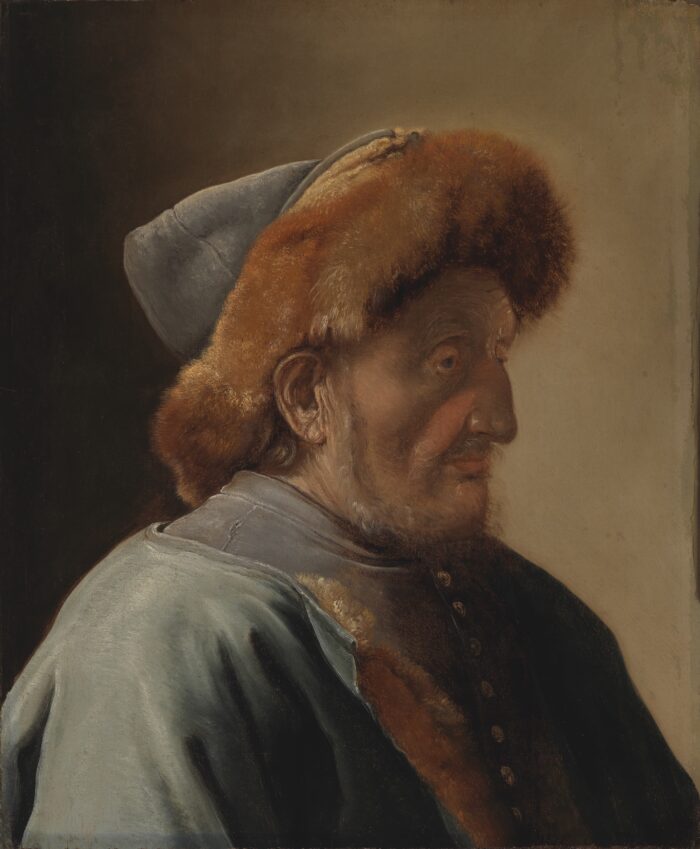
Monogrammist I.S., Old Man with a Fur Hat, 1640s
The Gösta Serlachius Fine Arts Foundation, Mänttä. Photo: Yehia Eweis
To achieve some of these goals and also to boost academic collaboration, I proposed a Serlachius Seminar, ideally to be organized biennially in partnership with Finnish universities and the Society for Art History in Finland. For the first of these events, in April 2022, I invited David de Witt from Museum Rembrandthuis to be our guest speaker. Although De Witt’s subject was Rembrandt, he linked his talk to interesting pieces in our collection.
One of these pieces was the painting Old Man with a Fur Hat (fig. 2), bought as a Jan Lievens from London in 1937 and attributed to him ever since. De Witt suggested that a more plausible attribution would be the enigmatic Monogrammist (or Master) I.S. and mentioned that Professor Volker Manuth had been studying this artist for years. He added that no exhibition has ever featured the work of this elusive painter. I immediately saw a wonderful opportunity – to raise the international profile of the Serlachius collection while at the same time expanding our institution’s network of scholars of Dutch art.
The project eventually developed into a partnership between Serlachius and Museum De Lakenhal in Leiden. Together with Janneke van Asperen, we curated the exhibition (fig. 3) and edited the catalogue, which was to be the first monographic publication on the artist. Volker Manuth and Marieke de Winkel helped us with their invaluable expertise and contributed to the book. David de Witt was very generous with his time throughout the process, sharing his specialized knowledge and introducing us to other scholars.
CODART helped significantly to make the “Master I.S.” research and exhibition project a success. Janneke and I were given the opportunity to introduce our project at the CODART 25 Speaker’s Corner in Stockholm. CODART also helped with publicity by posting a call for paintings and a lengthier introduction to the project on its website. Besides yielding a wealth of new contacts, this publicity identified the whereabouts of missing paintings and led to the discovery of previously unknown works.
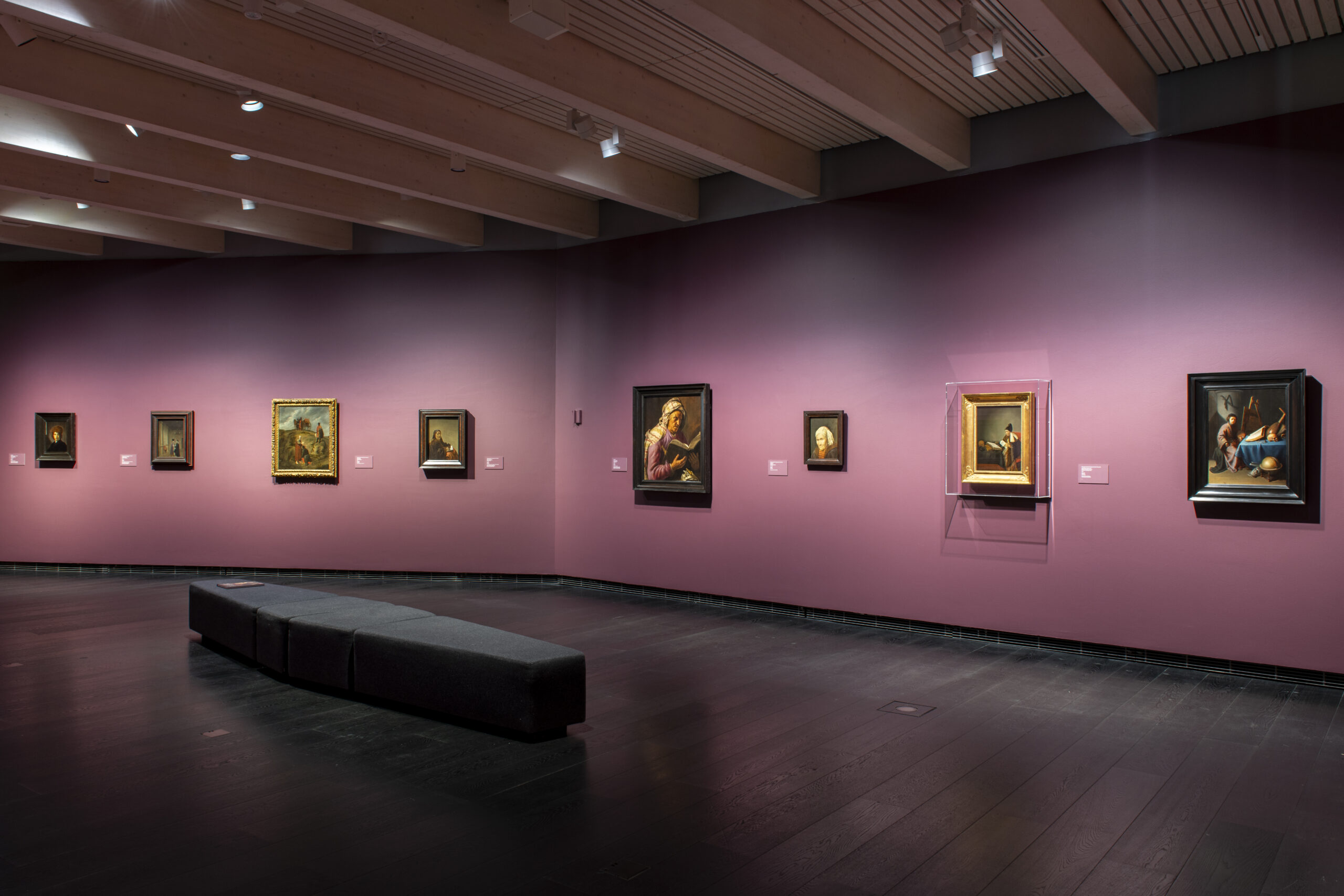
Installation view of the exhibition Master I.S.: Rembrandt’s Enigmatic Contemporary
Photo: Sampo Linkoneva
In Stockholm, I immediately felt welcome and accepted into the CODART community. I must confess that I initially suffered from something of an imposter syndrome, given that I had studied comparative literature before turning to art history — and even then, had started by focusing mainly on modern and contemporary art. This feeling soon passed, however. I have made many friends at CODART and see the conferences as major events in the calendar year.
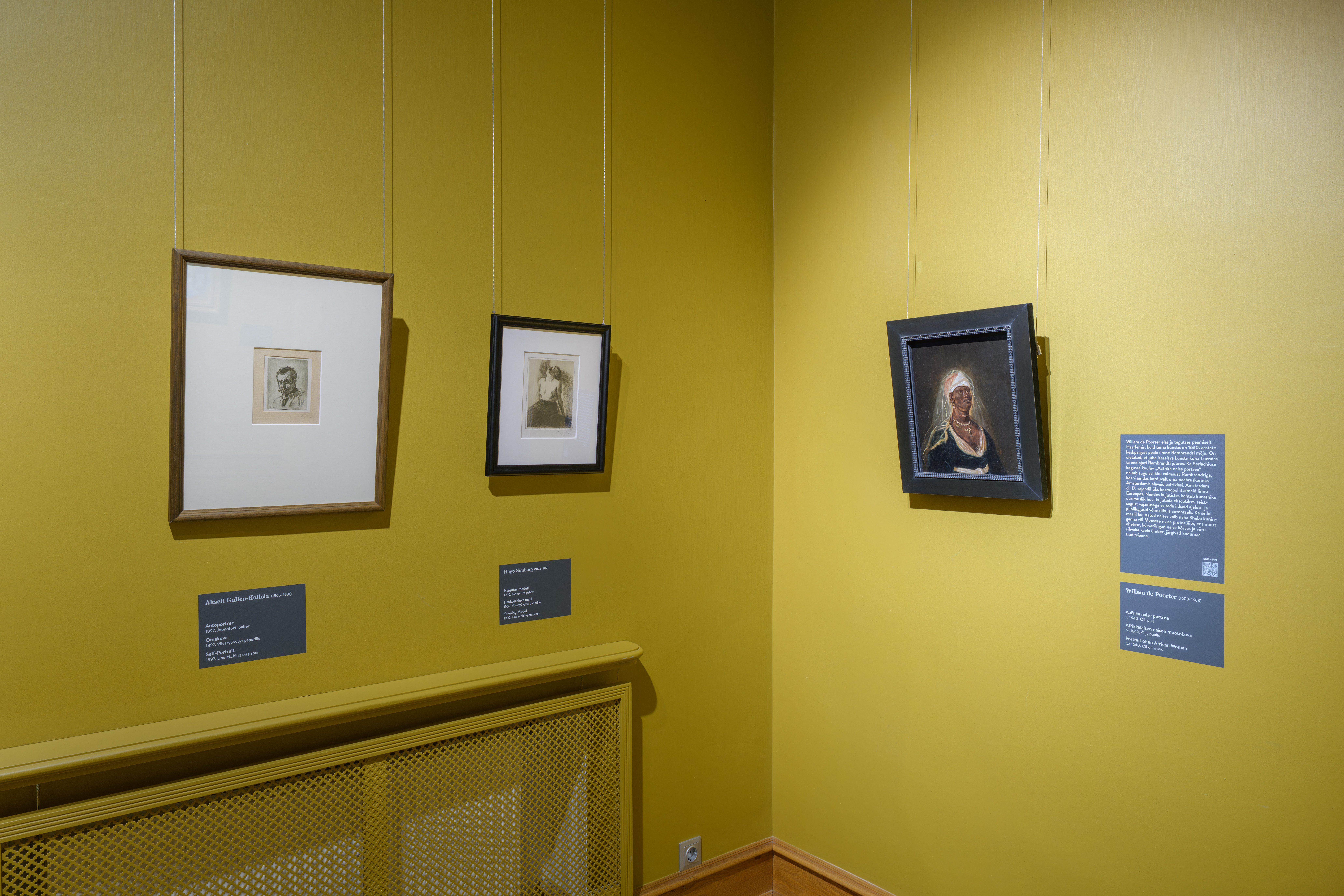
Fig. 4. Installation view of the exhibition Symphony of Art and Nature: The Serlachius Collection featuring Portrait of an African Woman by Willem de Poorter
My recent projects include curating an exhibition from our museum’s collection, together with fellow CODART member Greta Koppel, on show at Kadriorg Art Museum in Tallinn. The exhibition is entitled The Symphony of Art and Nature and it is the first time our collection is on view in Estonia. We decided to focus on the collection’s three main sections: Old Masters, Finnish art from the late nineteenth and early twentieth century, and contemporary art. Among the Dutch and Flemish exhibits is a recently restored painting by Willem de Poorter, Portrait of an African Woman (fig. 4).
Conducting research, writing, and curating exhibitions are the parts of my job I enjoy most. In the upcoming period, I should be able to focus on all of these, thanks to a generous grant from the Finnish Kone Foundation. In October 2026, I start a three-year research leave. I am to be the principal researcher in a team that will focus on the iconography of the moon from the early nineteenth century to the present day. I will be working with another art historian and a planetary geologist, the aim being to adopt an interdisciplinary approach to the subject. Although this means I will unfortunately have to miss the next few CODART conferences, I eagerly look forward to attending again in the future. In the meantime, I would be grateful for any information about interesting artworks featuring the moon in different collections.
Tomi Moisio is Curator at Serlachius in Mänttä, Finland. He has been a member of CODART since 2023.